
Potong Pasir heritage in Singapore is bound up with its neighbour MacPherson, and together the two estates tell a quietly remarkable story of farmland turned into homes, of distinctive architecture, and of a political history unlike anywhere else on the island. Sitting just north-east of the city, both areas grew out of rural land in the twentieth century, matured into settled residential districts, and held on to a strong sense of local identity even as Singapore rebuilt itself around them.
The names themselves carry the past. Potong Pasir is Malay for “to cut sand”, a reference to the sand quarrying and low-lying, water-fed land that once shaped the area. MacPherson takes its name from a nineteenth-century colonial figure, and the road and district that carry it became a spine for the neighbourhoods that followed. Read together, the two names point to a landscape of streams, market gardens and quarries that has almost entirely vanished beneath flats and expressways.
From farmland and quarries to settled estates
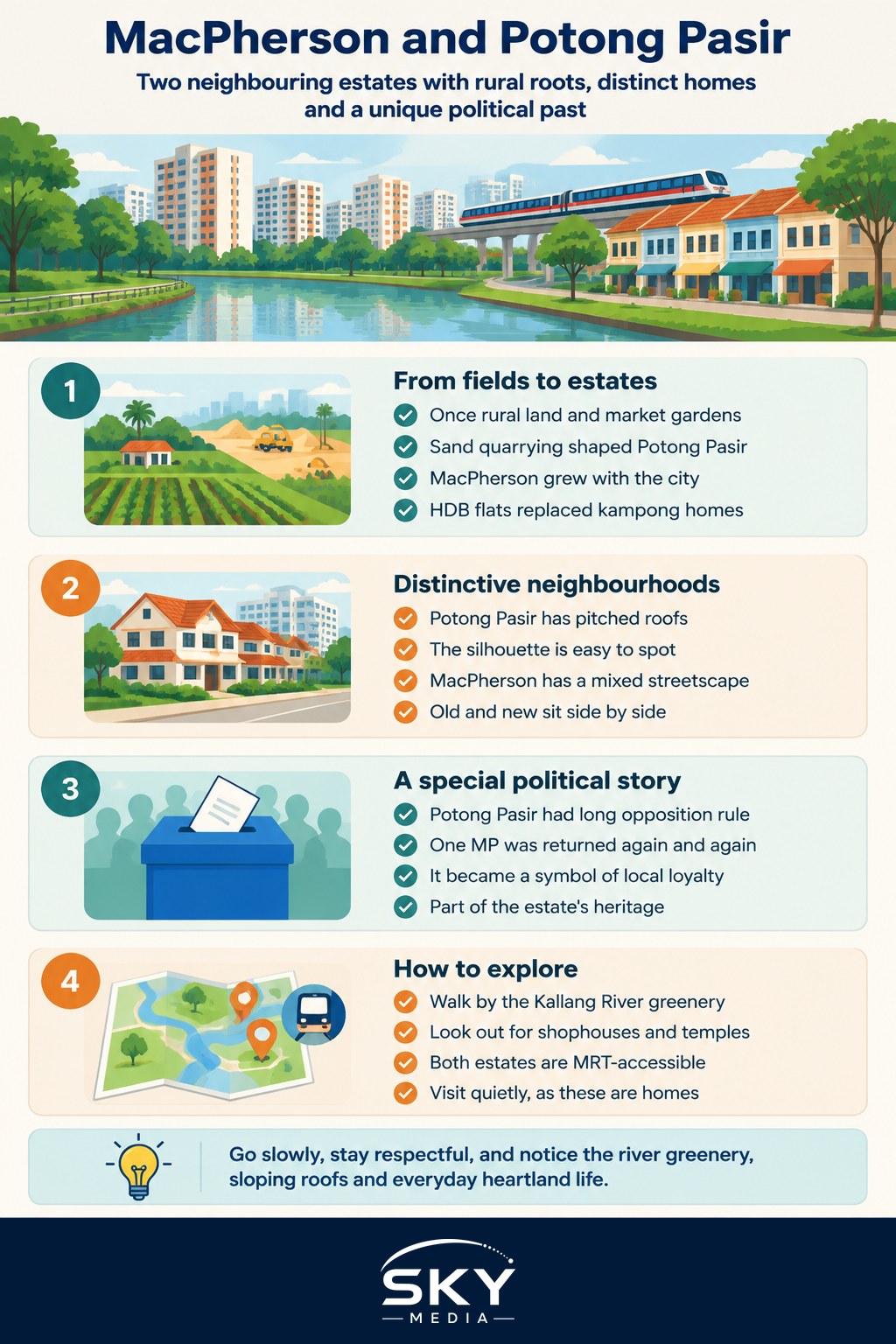
Before the estates, this was working countryside. Potong Pasir occupied low ground near the Kallang River system, prone to flooding, and generations of Chinese vegetable farmers, poultry keepers and small holders made a living from its market gardens. Sand was dug from the land, giving the place its name, and kampong houses clustered along the tracks and waterways. MacPherson, a little to the east, developed as a mix of light industry, shophouses and residential lanes as the city spread outward.
State housing changed everything. From the 1960s and 1970s onward the Housing and Development Board resettled farming families and built flats, draining and raising the flood-prone ground and replacing the gardens with public housing. It is worth remembering that this transformation belonged to the wider national story of moving people out of the kampong days of Singapore and into the new heartlands. Exact dates for particular blocks and schemes are best checked against HDB and the National Heritage Board, as this guide keeps precise figures general on purpose.
Distinctive estates and heritage landmarks
What sets Potong Pasir apart visually is its housing. The estate is known for blocks with unusually pitched, sloping roofs, a design that gives the neighbourhood an instantly recognisable silhouette rarely seen elsewhere in the HDB landscape. Set beside the greenery along the Kallang River, these homes have a character that longtime residents hold with real affection, and they remain a talking point for anyone crossing the area by train or road.
MacPherson, for its part, kept a more mixed grain. Older industrial buildings, temples, provision shops and low-rise flats sat alongside newer development, and the district has long functioned as a lived-in, working corner of the city rather than a showpiece. Both estates are threaded with the ordinary landmarks of the heartland, from wet markets and coffee shops to places of worship that grew with their communities. Much of the everyday texture here is the HDB heartland and void deck culture of Singapore in a particularly settled form.
A singular political history
Potong Pasir occupies a special place in Singapore’s political story. For a long stretch spanning the 1980s, 1990s and into the 2000s, it was one of only a small handful of constituencies held continuously by an opposition Member of Parliament, returning the same representative election after election. That long run made Potong Pasir a byword for a certain kind of independent local loyalty, and it gave the estate a public profile far larger than its modest size.
This history matters because it shaped how residents saw themselves and how the rest of the island saw them. The estate became closely associated with its long-serving representative and with a spirit of steadfast community identity. Whatever one’s politics, the sequence of results made Potong Pasir a landmark on Singapore’s political map, and that legacy remains part of the neighbourhood’s heritage today.
What remains and how to explore it
Much of the old landscape is gone, yet plenty survives to reward a visit. The sloping-roof blocks of Potong Pasir still stand as the estate’s signature, best appreciated on a slow walk along the river greenery, where the water and open space hint at the low, flood-prone ground of the past. MacPherson rewards the curious wanderer with its mix of eras, from older shophouse rows and temples to newer flats and transport links that have knitted the district more tightly into the city.
Both estates are easy to reach by MRT, and both sit close to the Bidadari area, whose old cemetery grounds have been redeveloped into new housing and parkland, another layer of the neighbourhood’s changing story. Explore the residential lanes quietly and respectfully, since these are people’s homes, and let the everyday rhythm of markets, void decks and coffee shops guide you.
Why these estates matter
MacPherson and Potong Pasir matter because they show how thoroughly Singapore remade its own land within living memory, and how identity survives that remaking. Farmland and quarries became flats, floods were tamed, and yet the estates kept distinctive faces, from sloping roofs to a singular political record. For more on how such districts fit the island’s wider pattern, see the guide to Singapore’s ethnic enclaves. Read together, these two neighbourhoods are a compact lesson in how a young nation built its heartlands without entirely erasing their character.
Frequently Asked Questions
What does Potong Pasir mean? It is Malay for to cut sand, a reference to the sand quarrying and low-lying, water-fed land that once shaped the area. The name points to a landscape of streams, market gardens and quarries that has almost entirely vanished beneath flats.
Why do the Potong Pasir flats have sloping roofs? The sloping, pitched roofs give the estate an instantly recognisable silhouette that is rarely seen elsewhere in the HDB landscape. The article does not give the design reasons, so for the details check HDB or the National Heritage Board.
How did flooding affect old Potong Pasir? Potong Pasir sat on low ground near the Kallang River system and was prone to flooding. When the Housing and Development Board resettled farming families, it drained and raised the ground before building public housing on it.
What was Potong Pasir’s political significance? For a long stretch from the 1980s into the 2000s it was one of only a small handful of constituencies held continuously by an opposition Member of Parliament. That made the estate a byword for independent local loyalty and gave it a profile far bigger than its size.
What can I do on a heritage walk around MacPherson and Potong Pasir? Walk along the river greenery to see the sloping-roof blocks, then explore MacPherson’s mix of older shophouse rows, temples and newer flats. Both estates are easy to reach by MRT. Keep quiet in the residential lanes, as these are people’s homes.