
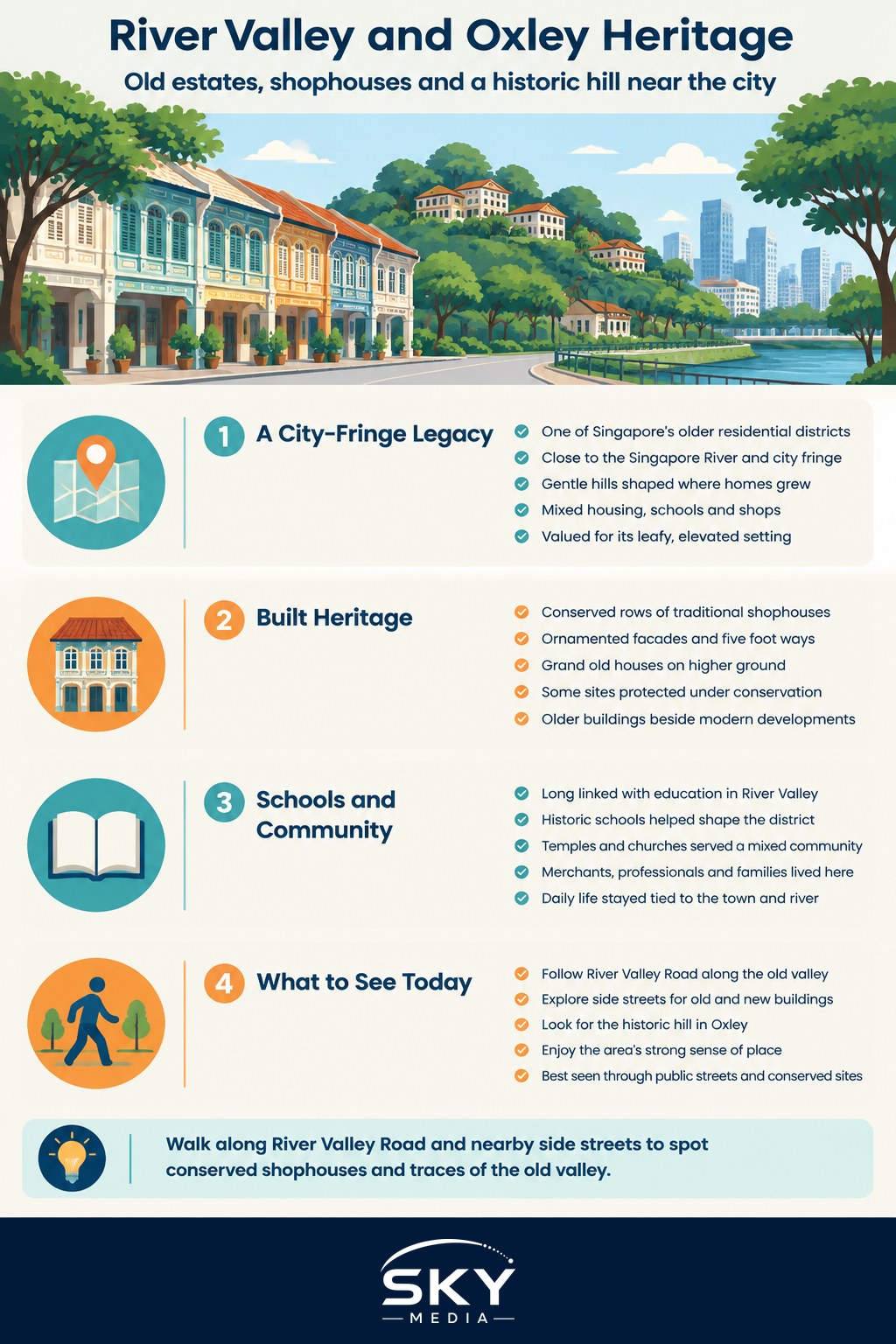
Set close to the Singapore River and the fringe of the city, River Valley and the Oxley area form one of the older residential districts on the island. This is a place of gentle hills, established schools, grand old houses and rows of shophouses, and River Valley heritage in Singapore is defined by the way city fringe living, education and community grew up together on and around a historic rise of land.
History and How the Area Developed
The area’s development is closely tied to its geography. River Valley Road follows the line of the river valley itself, connecting the town to the residential slopes to the west. In the nineteenth and early twentieth centuries, the district attracted merchants, professionals and a mixed community who built homes, shophouses and institutions on the higher, healthier ground away from the crowded town centre. Over time, River Valley became a settled residential and mixed use area, blending housing with schools, temples, churches and shops.
The Oxley area, on the higher ground nearby, is associated with one of the island’s historic hills. This elevated land was prized for its outlook and its cooler position, and it became home to bungalows and estates. The hill and its surroundings carry deep associations with early Singapore, and over the decades the land use shifted between grand residences and later redevelopment. Because parts of this history touch on private properties and sensitive sites, the area is best appreciated through its public streets and conserved buildings rather than through speculation about specific homes.
Heritage Landmarks and Old Estates
River Valley and Oxley are rich in built heritage. The district is known for its shophouses, many of which survive in conserved rows that showcase the ornamented facades, five foot ways and terraced form typical of Singapore’s traditional streetscape. The story of these buildings, their styles and their construction is told in our guide to Singapore shophouse architecture.
The area also holds a legacy of schools and institutions. River Valley has long been associated with education, and several schools have historic roots in the district, even where campuses have since moved or been rebuilt. Places of worship, including temples and churches serving the mixed community, add further layers to the area’s heritage. Grand old houses and estates on the higher ground reflect the district’s status as a desirable address on the city fringe.
Where buildings have been conserved, they enjoy protection under Singapore’s conservation framework, while other older structures have made way for modern condominiums and mixed use developments. This blend of conserved and rebuilt is characteristic of a district so close to the city, and it connects to the wider story in our overview of conservation of heritage buildings in Singapore.
Community and Cultural Roots
The community of River Valley and Oxley was always mixed, drawing merchants, professionals and families of many backgrounds who valued the district’s proximity to the town and its more elevated, leafy setting. Shophouse trades, temples, churches and schools all contributed to a layered local culture. The nearby river and the routes into the city shaped daily movement, tying the area to the commercial heart of Singapore while retaining its own residential character. This city fringe identity, with its shophouse rows and old world charm, links to the mood captured in our feature on old Singapore nostalgia.
What Remains and What Has Changed
River Valley and Oxley show both continuity and change. Conserved shophouses, some historic institutions and the general street pattern remain, giving the district a strong sense of place. At the same time, many older houses and estates have been replaced by high rise condominiums and modern developments, reflecting the intense demand for land near the city. The historic hill endures as a landmark of the area even as the buildings on and around it have changed over the years.
How to Explore River Valley and Oxley
A rewarding way to experience River Valley heritage in Singapore is a walk that combines the conserved shophouse streets with the slopes toward Oxley. Follow River Valley Road to sense the line of the old valley, then explore the side streets to admire the shophouses and the mix of old and new. The area sits within easy reach of the Singapore River and the city fringe, making it a natural extension of a wider heritage stroll. For related walks through historic districts, see our guides to Tiong Bahru heritage and to Singapore’s ethnic enclaves, which together round out a picture of the city’s older neighbourhoods.
Frequently Asked Questions
What are the five foot ways on River Valley shophouses? Five foot ways are the covered walkways at the front of shophouses, a typical feature of Singapore’s traditional streetscape. The conserved rows in the district also show ornamented facades and terraced form. A guide to shophouse architecture gives more detail.
Are the old buildings in River Valley protected? Where buildings have been conserved, they enjoy protection under Singapore’s conservation framework, while other older structures have made way for condominiums and mixed use developments. For the status of specific buildings, check with the relevant authority.
Why did people settle on the higher ground around Oxley? The higher ground was prized for its outlook and cooler position, and it drew merchants and professionals who wanted healthier ground away from the crowded town centre. It became home to bungalows and estates.
Can I visit the old houses on Oxley Hill? Parts of the area’s history touch on private properties and sensitive sites, so it is best appreciated through public streets and conserved buildings. Do not enter private grounds, and respect residents’ privacy.
How long does a River Valley heritage walk take? It depends on your pace and how many side streets you explore. Follow River Valley Road, then wander the shophouse streets and the slopes towards Oxley. It also extends easily into a wider heritage stroll along the Singapore River.
Further reading: Commonwealth and Tanglin Halt Heritage: Singapore’s Earliest Estates