

Point-reading pens, often called talking pens or 点读笔 (dian du bi) in Chinese, are a familiar sight in many bilingual homes. A child taps a word or picture in a compatible book and the pen reads it aloud, in Mandarin, English or both. For families in Singapore juggling English at school and Chinese as a Mother Tongue Language, a reading pen for kids can be a handy way to hear correct pronunciation when no fluent adult is around.
But pens vary a lot in what they actually do, and the book range matters more than the gadget itself. This guide explains how they work, what to check before buying, and how to get real value from one.
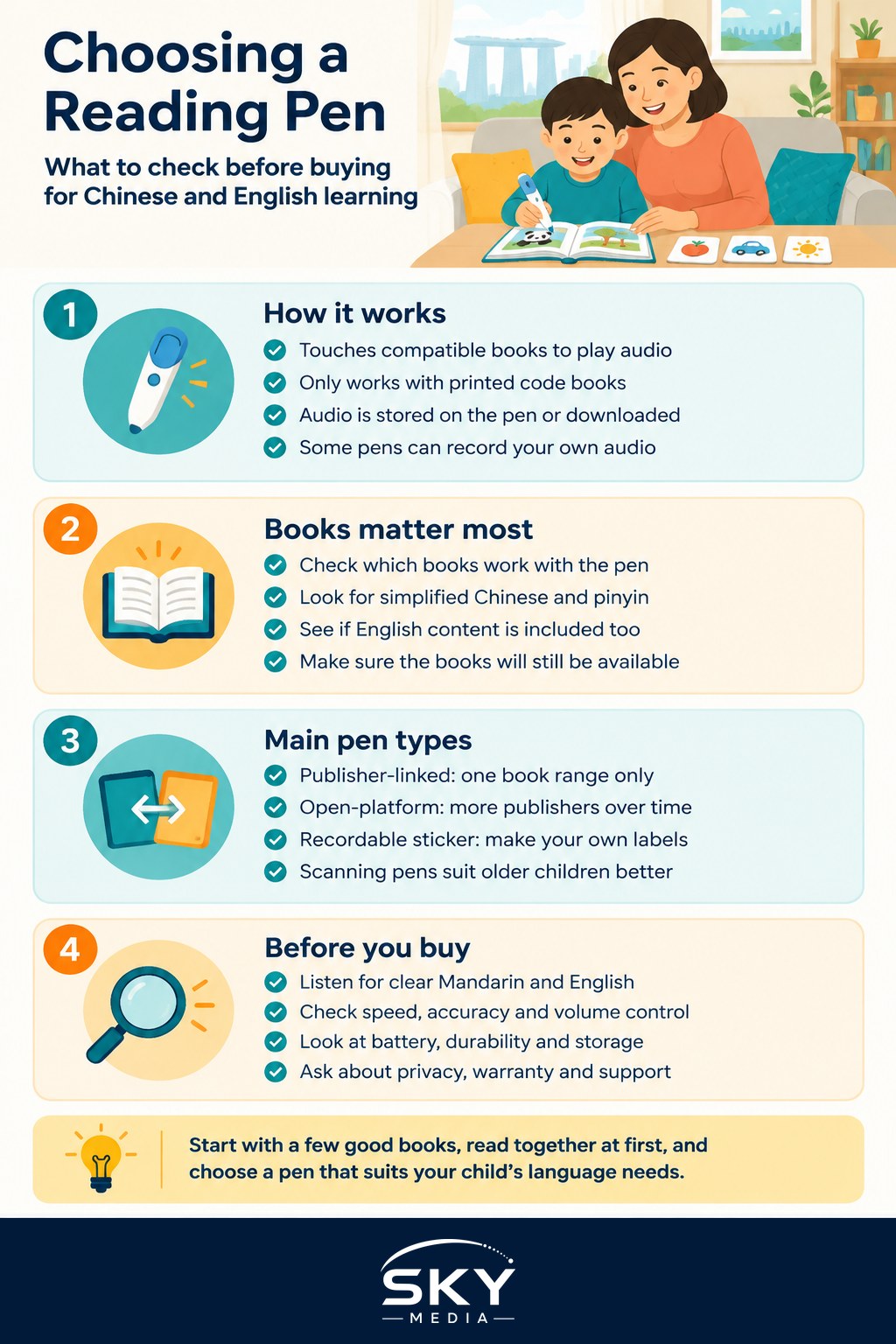
How Point-Reading Pens Work
Most reading pens use a small optical sensor in the tip. Compatible books are printed with tiny, almost invisible codes across each page. When the pen touches a spot, it reads the code and plays the matching audio file stored in its memory.
That design has a few practical consequences:
- The pen only works with books printed for it. An ordinary picture book from the library will not talk, however good the pen is.
- Audio has to be loaded onto the pen. Some pens come preloaded, while others need you to download audio packs for each book through a computer or app.
- Some pens let you record your own audio onto sticker labels, so you can make your own books, flashcards or household labels talk.
Other features you will see include a dictionary mode that reads single words, follow-and-repeat recording so a child can compare their voice with the model, and songs or quizzes for younger children.
Compatible Books Matter Most
Before choosing any pen, look at the books. A pen with brilliant sound but a thin library will gather dust.
Questions to ask:
- Which books work with this pen? Check whether the range covers your child’s current level and the next two or three years.
- Are the books in simplified Chinese and Hanyu Pinyin? Singapore schools teach simplified characters and pinyin. Materials from mainland China match this; some materials from elsewhere may use traditional characters or a different romanisation, which can confuse young learners.
- Is there English content too? Some pens support both languages across the same platform, which is handy for bilingual homes.
- Is the content suitable for Singapore? Chinese materials made for mainland China are generally helpful for listening and vocabulary, but they will not track the local Chinese syllabus. Treat them as extra exposure, not a replacement for school materials.
- Can you still buy the books in a year or two? Pens tied to a single publisher depend on that publisher continuing to print and support books.
If you are moving from China, you may already own a pen and books from home. Check that the pen charges safely on Singapore’s 230V supply with a proper local adapter, and that any app or download service it relies on is accessible here.
Comparing the Main Types of Reading Pen
Pens on the market fall roughly into a few types. Prices change and differ by seller, so compare like for like.
| Type | How it works | Good for | Watch out for |
|---|---|---|---|
| Publisher-linked pen | Works with one publisher’s printed range | Families who like that series and want a simple setup | Locked to one catalogue; check it is still supported |
| Open-platform pen | Supports multiple publishers’ books via downloadable audio | Families wanting a wider choice of books over time | Downloads may need an app or computer; check the process |
| Recordable sticker pen | Plays audio you record on code stickers | DIY books, flashcards, labelling home items in two languages | Takes parent time to set up |
| Scanning translation pen | Scans printed lines of text and reads or translates them | Older children reading ordinary books | Accuracy varies; can become a shortcut instead of reading |
Scanning pens are a different category from point-reading pens. They work with almost any printed text, but they rely on text recognition and machine translation, so they suit older primary or secondary students checking unfamiliar words rather than young children learning to read.
What to Check Before You Buy
Once you have a shortlist, test the pen if you can, or read reviews from parents with children of the same age.
- Audio quality and voice. Listen for clear, natural Mandarin with correct tones, and English with a neutral, clear accent. Robotic or muffled audio teaches poor pronunciation.
- Speed and accuracy. The pen should respond quickly and reliably. Slow or missed taps frustrate young children.
- Volume and earphones. A volume limit and an earphone jack or Bluetooth headphones option help in shared spaces.
- Battery and charging. Check the charging port type and how easy it is to recharge.
- Durability. Pens get dropped. A sturdy body and a protective cap make a difference.
- Storage. If you plan to use many books, check how much audio the pen can hold.
- Privacy. If the pen or its app connects to the internet or records voices, read what data is collected and where it is stored.
- Warranty and support. Buy from a seller who can help with faults locally, and keep the receipt.
Getting Real Value at Home
A reading pen works best as a tool alongside an adult, not as a babysitter. A few habits help:
- Read together first. Sit with your child for the first few sessions. Ask about the pictures, and let the pen fill in pronunciation you are unsure of.
- Use follow-and-repeat. Encourage your child to repeat words and short sentences aloud. Speaking practice is often where Mother Tongue learners struggle most.
- Move from pen to page. As your child gains confidence, encourage them to read a line first, then check with the pen.
- Label the home. With sticker pens, label everyday items in Chinese and English. Children enjoy tapping the fridge, door and toy box.
- Keep sessions short. Ten to fifteen minutes of focused use is often more useful than an hour of random tapping.
Reading pens are generally screen-free, which many parents like. Still, keep an eye on how your child uses it. If tapping becomes a game in itself, with no reading happening, steer back to shared reading. Our guide on nurturing a love of reading in school-age kids has more ideas.
Matching the Pen to Your Family
The right choice depends on which language needs support at home:
- English-speaking homes building Chinese: a pen with good Mandarin audio and simplified Chinese books gives children exposure to tones and vocabulary that parents may struggle with. Pair it with ideas from our guide on building Mandarin confidence in English-speaking kids.
- Chinese-speaking homes building English: look for strong English content with clear pronunciation, and use it alongside everyday English conversation. See our tips on helping children learn English in Chinese families.
- Balanced bilingual homes: a pen that supports both languages across one platform keeps things simple.
Whichever pen you choose, the books, the routine and your involvement will shape the results far more than the specifications on the box. Start small with a few well-chosen books, see how your child responds, and build the library from there.