
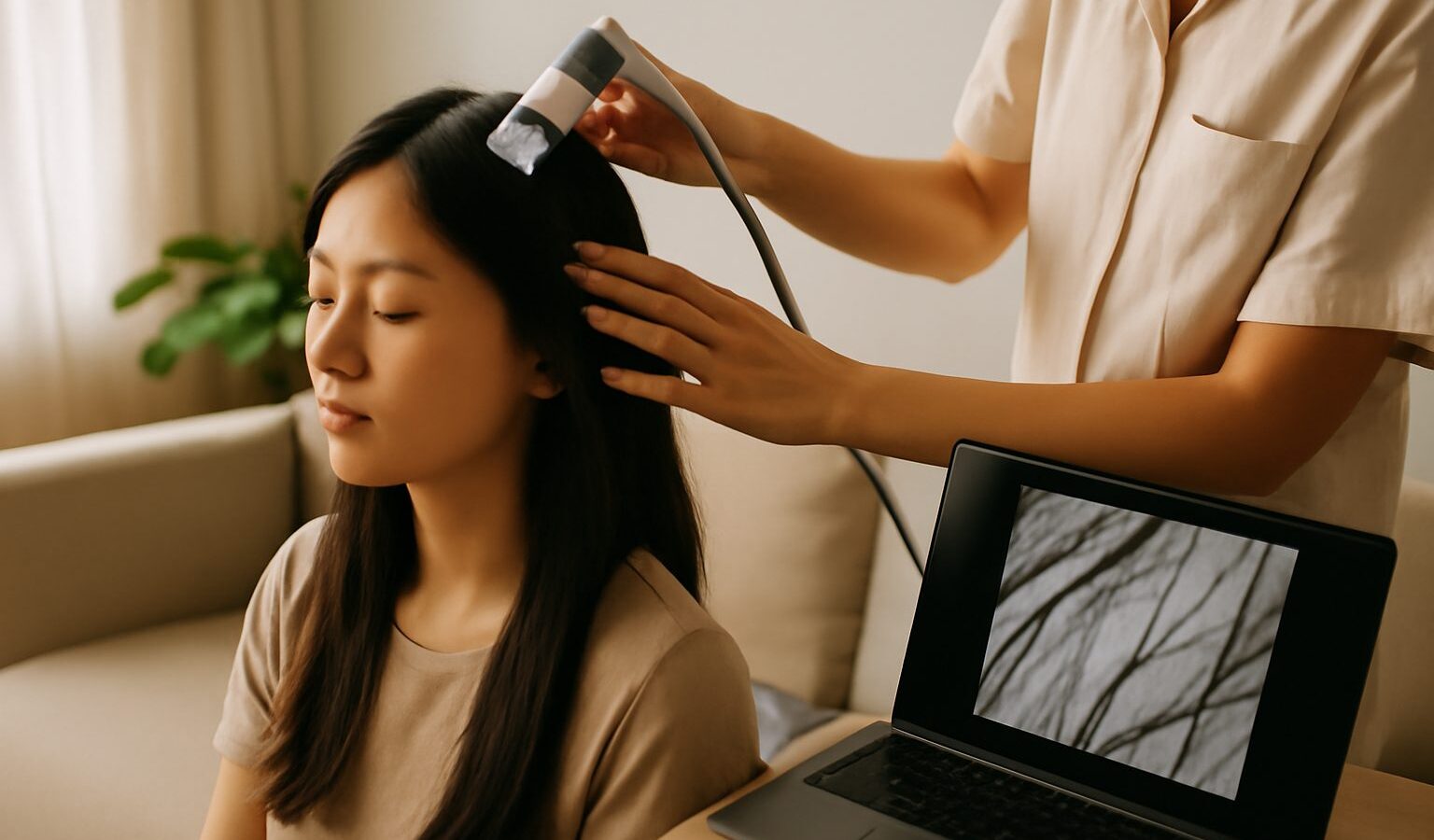
If you have walked past a hair studio in a mall, you have probably been offered a free scalp check. A staff member places a small camera on your head, and suddenly you are looking at your own follicles on a screen, often with a worrying amount of oil or flakes. Scalp analysis in Singapore ranges from these quick salon scans to detailed assessments by a dermatologist. This guide explains what the imaging actually shows, how salon and clinic checks differ, and when paying for one is genuinely useful.
This is general information, not medical advice. For sudden, patchy or heavy hair loss, or a painful or inflamed scalp, see a doctor.
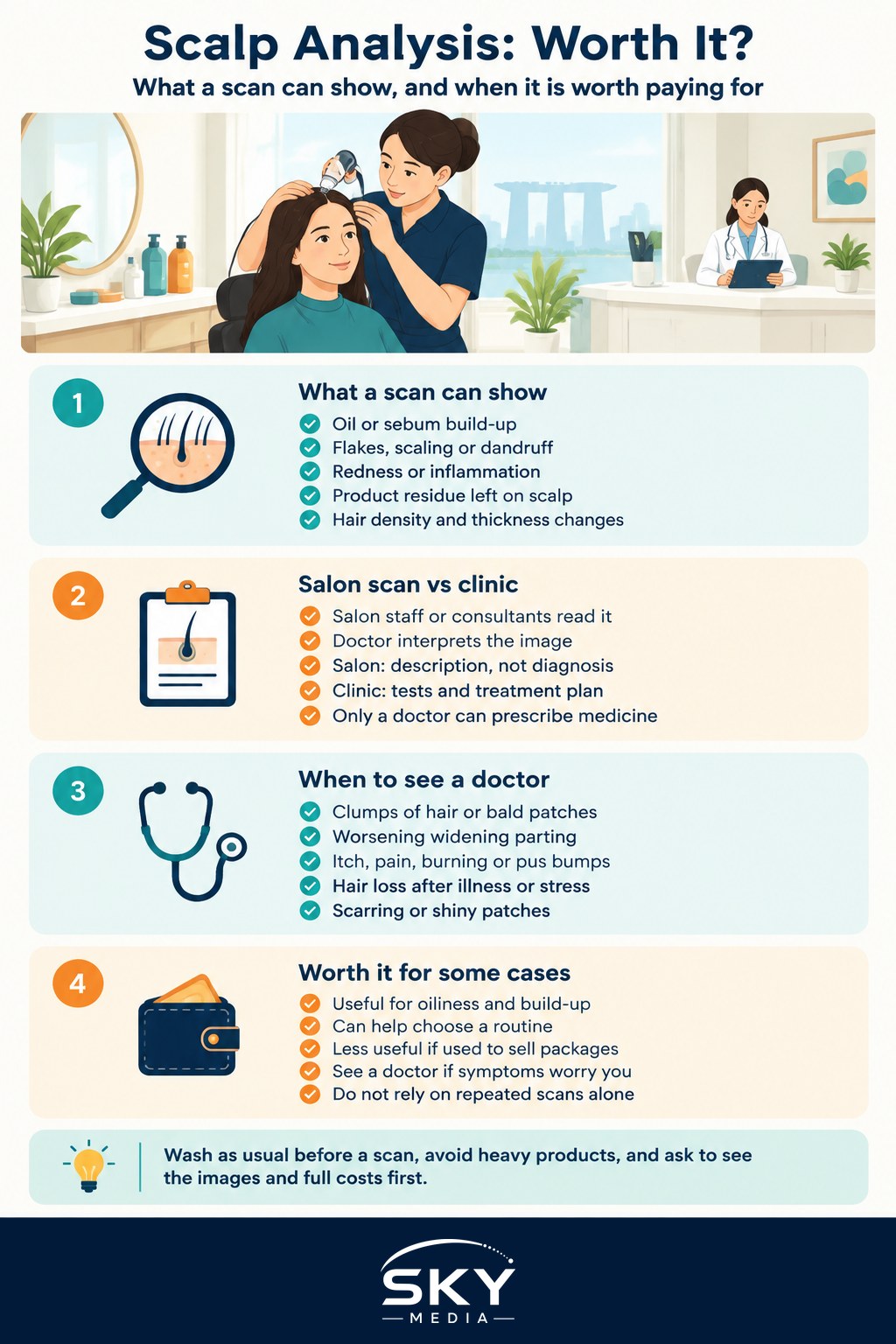
What Scalp Analysis Actually Is
At its simplest, a scalp analysis uses a handheld digital microscope to magnify the skin and hair many times. The image appears on a screen or tablet so you can see what the naked eye cannot.
In a medical setting, the same idea is called trichoscopy, the use of a dermatoscope (a magnifying device dermatologists also use to examine moles) on the scalp and hair. A trained doctor reads specific patterns in the follicles, hair shafts and blood vessels to help identify conditions.
The equipment can look similar in both settings. The real difference is the training of the person interpreting the image and what happens next.
What a Scan Can Show
A magnified scalp image can reveal:
- Oil (sebum) build-up: shiny or yellowish film around follicles, common in Singapore’s humid climate.
- Flaking and scaling: dry flakes, or greasy yellow scales that may point to seborrhoeic dermatitis, a common cause of dandruff.
- Redness and inflammation: pink or red patches, which can signal irritation, sensitivity or a skin condition.
- Product residue: dry shampoo, styling products or sunscreen that has not been rinsed out properly.
- Hair density: how many hairs grow from each follicle opening, and how close together the follicles are.
- Variation in hair thickness: a mix of thick and much finer hairs can suggest miniaturisation, a feature of pattern hair loss.
- Broken hairs or unusual shaft shapes, which a doctor may link to specific conditions.
What a scan cannot do on its own is tell you why something is happening. Hair shedding can be linked to stress, illness, hormones, nutrition, medication, genetics and more, and sorting these out needs a medical history and sometimes blood tests.
Salon Scan vs Dermatologist Assessment
| Feature | Hair studio or salon scan | Dermatologist or clinic assessment |
|---|---|---|
| Who reads the image | Trained salon staff or consultants | A doctor, often a dermatologist |
| What you get | Description of oiliness, flakes, density | Diagnosis, possible tests and treatment plan |
| Typical cost | Often free or low, linked to product or package sales | Consultation fee, plus any tests |
| Can prescribe medicine | No | Yes |
| Best for | Understanding oiliness and build-up, choosing a routine | Hair loss, persistent itch, rashes, scarring |
| Main caution | Sales pressure for prepaid treatment packages | Waiting time and cost of specialist care |
Fees vary widely and change, so ask about the cost of any consultation, scan or follow-up before you agree to it.
How Salon Scans Work in Practice
Hair studios and scalp care centres commonly use the scan as the start of a consultation. You may be asked about your washing routine, products and diet, then shown images of several spots on your head. Some save the photos so you can compare progress after treatments such as scalp cleansing, steaming or massage.
Used well, this can be helpful. Seeing heavy build-up may convince you to change how you wash, and before-and-after images can show whether a routine is working. Our guides to scalp care and dandruff and oily scalp and greasy roots explain the daily habits that usually make the biggest difference.
The common downside is that a free scan is often a sales tool. Close-up images naturally look dramatic, and a consultant may recommend a multi-session package on the spot. Before you commit:
- Ask what exactly they see and what it means, in plain terms.
- Ask whether a doctor should look at it. A responsible salon will refer you if they see signs of a medical problem.
- Ask for the full price, number of sessions and refund terms in writing.
- Take time to decide. Prepaid packages can be hard to cancel, and if a business closes you may lose unused sessions. The Consumers Association of Singapore (CASE) advises consumers on prepaid package risks, so check its current guidance.
- Be wary of promises to “regrow” hair through salon treatments alone. Claims like this should be backed by evidence and are best discussed with a doctor.
When a Medical Assessment Makes Sense
Consider seeing a GP (family doctor) or a dermatologist, rather than relying on a salon scan, if you notice:
- Hair falling out in clumps, round bald patches or a sudden increase in shedding.
- A widening parting or receding hairline that is getting worse.
- Persistent itching, pain, burning, pus bumps or scaly plaques that do not improve with a change of shampoo.
- Hair loss after an illness, pregnancy, major stress or starting a new medication.
- Scarring or shiny patches where hair no longer grows.
A GP can do a first assessment and refer you to a dermatologist if needed. In the public system, a referral from a polyclinic or GP is usually needed for subsidised specialist care at a hospital or the National Skin Centre. Subsidy eligibility depends on residency status, so check with the clinic. A doctor may combine trichoscopy with blood tests or, in some cases, a small scalp biopsy to reach a diagnosis.
Is Scalp Analysis Worth It?
It depends on what you want from it.
- Worth it, often free: if you are curious about oiliness, flaking or build-up and want help choosing a routine, a salon scan can be informative, provided you do not feel pressured into buying.
- Worth paying for: a medical consultation if you have noticeable hair loss, a stubborn scalp condition or symptoms that worry you. Early assessment gives more treatment options for many types of hair loss.
- Less useful: repeated scans to track small changes when your scalp feels healthy, or scans used mainly to sell packages.
You can also do a lot at home. Gentle cleansing suited to your scalp type, rinsing products out thoroughly and regular scalp exfoliation for build-up help many people without any equipment. If things do not improve within a few weeks, that is the point to see a professional.
Getting the Most From Your Appointment
- Wash your hair as usual a day or two before, unless the provider tells you otherwise, so the scan reflects your normal scalp.
- Avoid heavy styling products on the day.
- Bring a list of products you use and any medications or supplements.
- Ask to see the images and, if possible, keep copies for future comparison.
A scalp scan is a useful window into your scalp, but it is the interpretation and advice that follow that make it worth your time and money.
Further reading: Head Spa in Singapore: Scalp Treatments for Stress Relief · Scalp Micropigmentation in Singapore and Who It Suits