

For most of the twentieth century, a traveller leaving Singapore by train would begin the journey at Tanjong Pagar Railway Station. This grand building near the southern edge of the city was the terminus of the line that ran up the Malay Peninsula, and for generations it was the gateway between the island and its neighbours. Today the trains no longer call there, yet the station survives as a conserved landmark and a monument to a distinctive chapter in the country’s story.
A terminus built for a golden age of rail
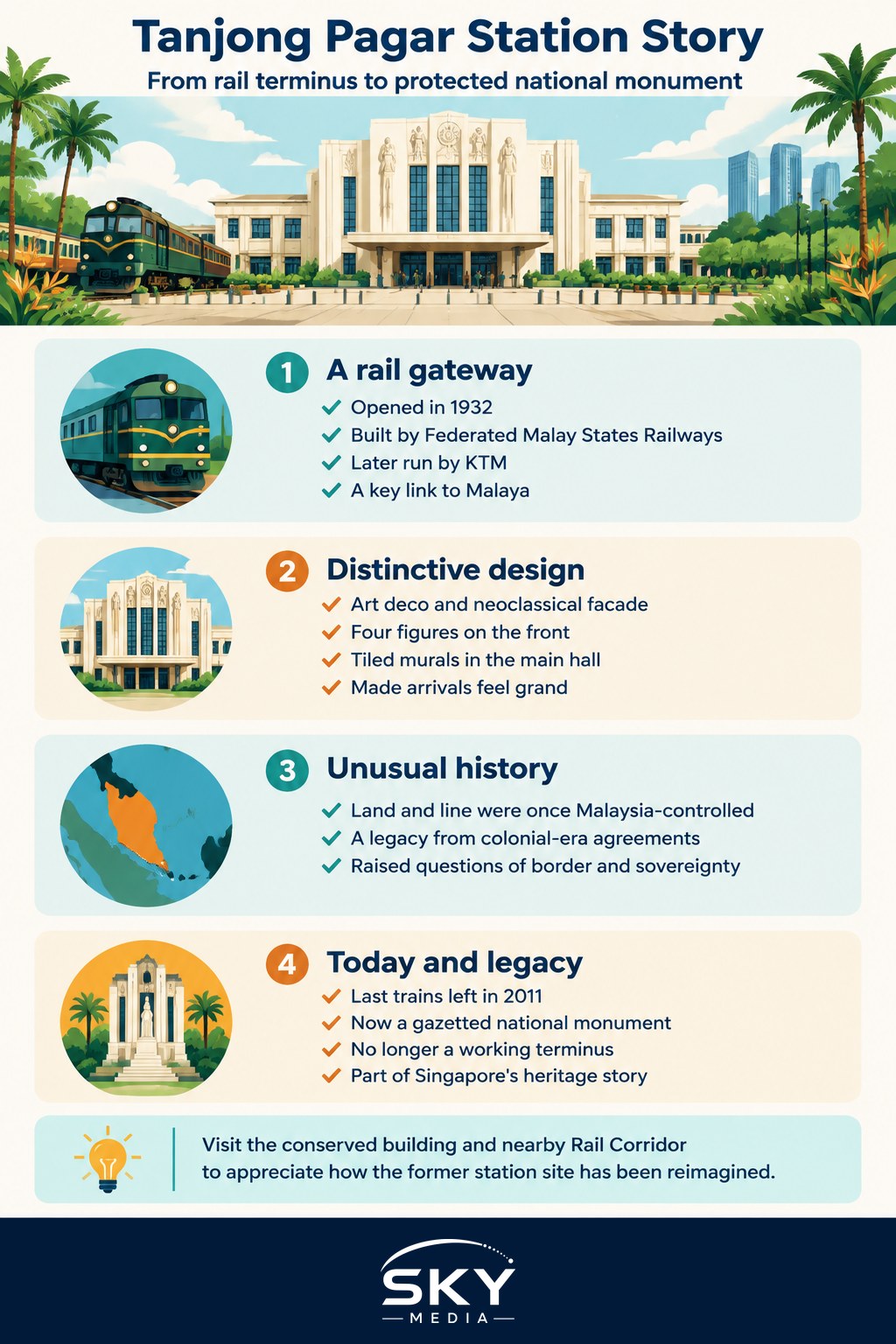
Tanjong Pagar Railway Station opened in 1932, in the years before the Second World War when rail travel was at its height across the region. It was built by the Federated Malay States Railways, the operator whose successor, the Malaysian railway company known as Keretapi Tanah Melayu or KTM, would run services from the station for decades. The station replaced an earlier terminus and gave Singapore a building fit for the ambitions of the age.
The architecture is one of the reasons the station is so loved. The main facade is a strong example of the art deco and neoclassical styles that were fashionable at the time, with a broad frontage crowned by four large figures that represent agriculture, commerce, transport, and industry, the pillars of the economy the railway was meant to serve. Behind the facade lies a soaring main hall, its walls decorated with large tiled murals depicting scenes of Malayan life and industry. The overall effect is monumental yet warm, a place designed to make arrival and departure feel significant. Those interested in how the building sits within the wider design story of the island can read our Singapore architecture styles guide.
There was a further curiosity that fascinated many visitors. For a long stretch of its history the land on which the station stood, together with the railway line running through the island, was controlled by Malaysia rather than Singapore, a legacy of agreements dating back to the colonial period. That arrangement gave the station an unusual status and made it a place where questions of border, sovereignty, and shared history were quietly present in everyday travel.
From working station to conserved monument
The station worked hard for the better part of eight decades. Passengers passed through its hall on their way to Kuala Lumpur and beyond, and the platforms saw the daily rhythm of a busy terminus. Over time, though, the arrangement of the railway land became the subject of long negotiations between Singapore and Malaysia. Those talks eventually led to an agreement to move the terminus and to return the railway land to Singapore.
The last trains called at Tanjong Pagar in 2011, when operations were shifted to a station in the north of the island and the old line through the city ceased to carry regular services. The closing of the terminus was an emotional moment for many, who gathered to mark the final departures and to say farewell to a building woven into their memories. That sense of affection for places that shape ordinary life is something we explore in our collection on old Singapore nostalgia.
The station itself has been protected. It was gazetted as a national monument, which secures its future and places it among the most valued heritage buildings on the island, as set out in our guide to Singapore’s national monuments. Since the trains stopped, the building and the disused railway corridor that stretches from it have taken on a new role. The former rail route has been reimagined as a green public space, a subject we cover in detail in our piece on the Rail Corridor and railway heritage in Singapore.
The status of Tanjong Pagar Railway Station today is therefore clear. It is conserved and protected, no longer a working terminus but preserved as a monument and being adapted for public and cultural use as plans for the wider area take shape. Its grand hall, its four watchful figures, and its tiled murals remain, holding the memory of the age when a train from Singapore could carry you the length of the peninsula. For anyone tracing the arc of the island’s development, the station is a fixed point, and it appears naturally in any Singapore history timeline that follows the growth of the modern city.
Frequently Asked Questions
When did the last trains leave Tanjong Pagar Railway Station? The last trains called there in 2011, when operations shifted to a station in the north of the island and the old line through the city stopped carrying regular services. Many people gathered to mark the final departures and say farewell.
What do the four statues on the station facade represent? The four large figures crowning the frontage represent agriculture, commerce, transport and industry. These were the pillars of the economy that the railway was meant to serve. They are part of the art deco and neoclassical look that made the station so loved.
Why was the railway land controlled by Malaysia? It was a legacy of agreements dating back to the colonial period, so the land and the line running through the island were controlled by Malaysia rather than Singapore. Long negotiations later led to an agreement to move the terminus and return the railway land to Singapore.
What happened to the old railway tracks after the trains stopped? The disused railway corridor stretching from the station has been reimagined as a green public space. The station building itself is conserved and protected as a national monument, and it is being adapted for public and cultural use as plans for the wider area take shape.
What can visitors still see inside the old station hall? The soaring main hall survives, with walls decorated by large tiled murals depicting scenes of Malayan life and industry. Access and opening arrangements can change while the building is being adapted, so check current announcements before planning a visit.
Further reading: Old Hill Street Police Station History · A Day in Tanjong Pagar