
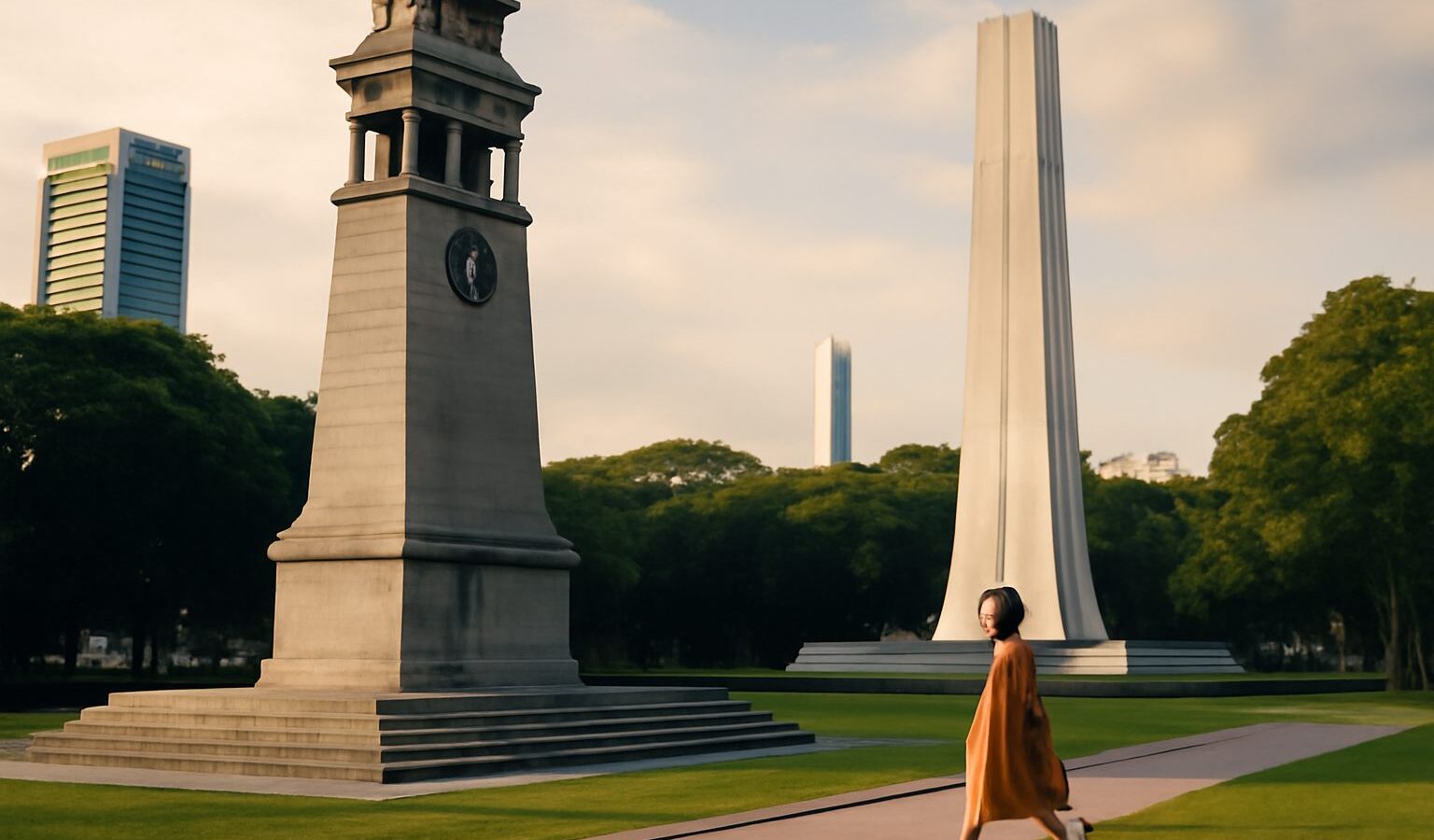
Standing near the waterfront in the civic district, a tall stone monument rises above the surrounding lawns, sober and dignified. This is the cenotaph singapore, a memorial to the war dead that has kept its quiet vigil by the Esplanade for many decades. The word cenotaph means an empty tomb, a monument raised to honour those who died elsewhere and whose graves may lie far away or remain unknown. It is a place of remembrance, and it anchors a wider network of war memorials across the island.
What the Cenotaph Commemorates
The Cenotaph was erected to honour those who died in service during the First World War, and it was later expanded in its dedication to remember the dead of the Second World War as well. In this way the single monument gathers the memory of those lost across both global conflicts, honouring soldiers and others who gave their lives. It follows a tradition of cenotaphs raised across many countries after the First World War, all sharing the same essential purpose, to give the living a place to mourn and to lay tributes to the fallen.
As an empty tomb, the Cenotaph does not mark a grave. Instead it stands for all those whose resting places are elsewhere, offering a focal point for collective grief and gratitude. Its position in the heart of the civic district, close to the sea and to the institutions of state, reflects the seriousness with which the community regards the debt owed to the war dead.
Its Design and Significance
The Cenotaph is a work of restrained, classical dignity. Built of stone and rising in clean, tapering lines, it presents a solemn face to the public spaces around it. Inscriptions on the monument record its dedication to the dead of the world wars, and the addition of the Second World War dedication after that conflict shows how the memorial grew to encompass fresh losses. Its sober design avoids ornament, letting the scale and the inscriptions carry the weight of its meaning.
The monument is recognised as part of Singapore’s built heritage and its ensemble of national memorials, a theme explored in national monuments Singapore. It stands within a landscape of remembrance that includes other significant sites. Nearby, the Civilian War Memorial honours the civilian victims of the Japanese Occupation, while further out the Kranji War Memorial commemorates service personnel who died in the region. Together these sites form a network in which different kinds of loss are each given their proper place and honour.
The Cenotaph’s meaning is deepened by its context. Singapore’s experience of the Second World War, from the fall of the island to the years of Occupation, is a defining chapter of its modern history, traced in Singapore in WWII. The Cenotaph, first raised for an earlier war, became a bridge across the memory of both conflicts.
How the War Dead Are Honoured Today
Remembrance in Singapore is observed with care throughout the year. Commemorative services are held at war memorials to honour the dead, with wreaths laid, silence observed, and representatives of the community, veterans’ associations, families and officials taking part. These ceremonies are dignified and communal, and they keep the memory of the fallen alive across generations.
The national calendar reinforces this remembrance. Total Defence Day, marked around the anniversary of the fall of Singapore, invites reflection on the lessons of the war years and on the value of a united and resilient society. The pairing of solemn commemoration with civic reflection gives the memorials a living role, not merely as relics of the past but as touchstones for the present.
Visitors to the Cenotaph today find a calm space amid the busy civic district, a place to pause and consider the cost of war. Its inscriptions and its plain, strong form speak without embellishment. For those wishing to understand the full sweep of these events, the Singapore history timeline lays out the key dates, and the National Heritage Board and official histories remain the authoritative sources.
The cenotaph singapore endures as a monument to remembrance, an empty tomb that holds a full measure of meaning. In honouring those who died in the world wars, it reminds a peaceful nation of the sacrifices made in harder times, and it takes its place among the memorials that together ensure the war dead of Singapore are never forgotten.