
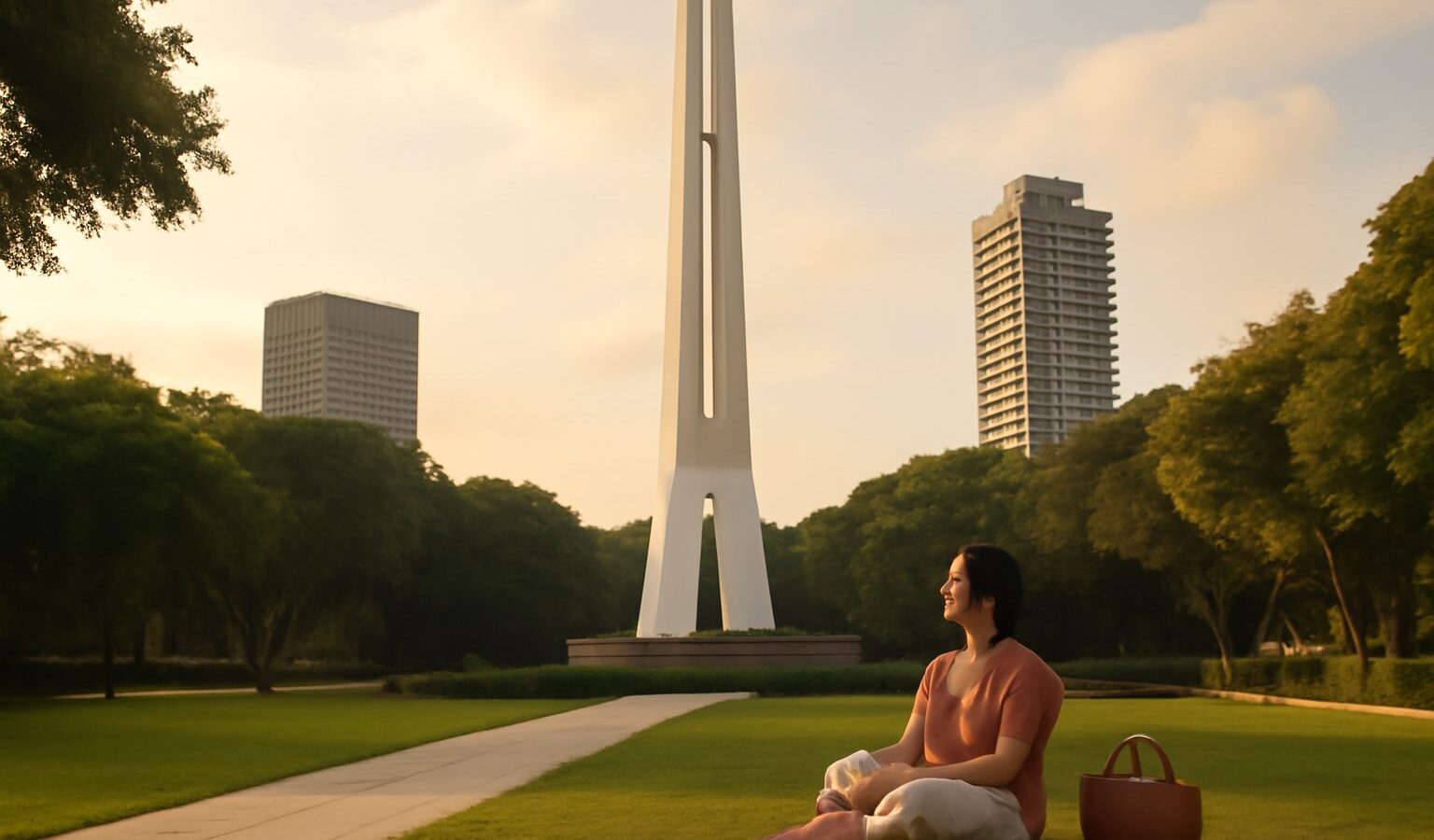
Rising from a landscaped plot in the civic heart of the city, four tall white pillars reach toward the sky, joined at the base and tapering as they climb. This is the civilian war memorial singapore, one of the most significant sites of remembrance in the country. It was raised to honour the civilians of all communities who died during the Japanese Occupation of the Second World War, and it has become a place where the nation gathers each year to remember them with dignity and respect.
What It Commemorates
The memorial is dedicated to the civilian victims of the Occupation, the ordinary residents of the island who lost their lives during those years of hardship and violence. Foremost among the events it recalls is the Sook Ching, the systematic screening and mass killing of civilians in the aftermath of the fall of Singapore, in which the victims numbered in the thousands. The wider suffering of the Occupation, from scarcity and fear to loss and displacement, is also held within its meaning. The background to these events is set out in the companion articles on the Sook Ching and WWII memorial sites and on Singapore in WWII.
The memorial’s origins lie in the post war recovery of remains from sites connected to the killings. This solemn discovery moved the community to create a permanent, unified place of mourning. Importantly, the memorial was conceived to honour victims from all of Singapore’s communities together, a shared monument to a shared loss. Estimates of the number of civilian dead vary and remain the subject of historical study, and the memorial stands for all of them without seeking to fix a single figure.
Its Design and Significance
The most striking feature of the memorial is its form. Four white columns rise together from a common base, tall and slender against the surrounding greenery and the city beyond. The four pillars are widely understood to represent the four major communities of Singapore, the Chinese, Malay, Indian and other populations, standing side by side in shared grief and shared remembrance. In everyday speech the monument is sometimes affectionately called the chopsticks because of its distinctive shape, but its purpose is deeply serious.
The design carries a clear message. By binding the four pillars at a single base, it expresses the idea that the communities suffered together and remember together, that the tragedy of the Occupation belonged to the whole people of the island rather than to any one group. Set within a quiet, well kept garden away from the rush of traffic, the memorial offers a contemplative space in the middle of a dense city. Its clean, vertical lines encourage the eye upward and the mind toward reflection.
The memorial is recognised as an important part of Singapore’s heritage landscape, a subject explored more broadly in national monuments Singapore. It sits alongside other places of war remembrance across the island, including the Kranji War Memorial, which honours service personnel, giving the country a network of sites that together tell the story of the war and its cost.
How It Is Honoured Today
Each year a commemorative service is held at the memorial to remember the civilian victims of the Occupation. Wreaths are laid, a moment of silence is observed, and representatives of the community, survivors’ families, religious groups, students and public officials gather in a dignified ceremony. These observances are quiet and respectful, focused wholly on remembrance.
The date of the annual commemoration falls around the anniversary of the fall of Singapore, a period that also coincides with Total Defence Day, when the nation reflects on the lessons of the war and the value of unity and resilience. The pairing is fitting, for the memorial speaks to both loss and to the resolve that such suffering should not be repeated.
Beyond the formal ceremonies, the memorial is open as a place of individual reflection. Visitors pass through the garden, read the inscriptions, and pause beneath the pillars. Schools and heritage programmes bring students to learn the history it embodies, ensuring that the memory is carried forward. For authoritative detail on the memorial and the events it marks, the National Heritage Board and official histories remain the proper sources, and the Singapore history timeline helps place these events in order.
The civilian war memorial singapore endures as a place where a nation keeps faith with its dead. In its four rising pillars, joined at the root, it holds a simple and enduring truth, that the people of the island suffered together and remember together, and that the civilian victims of the Occupation will not be forgotten.