
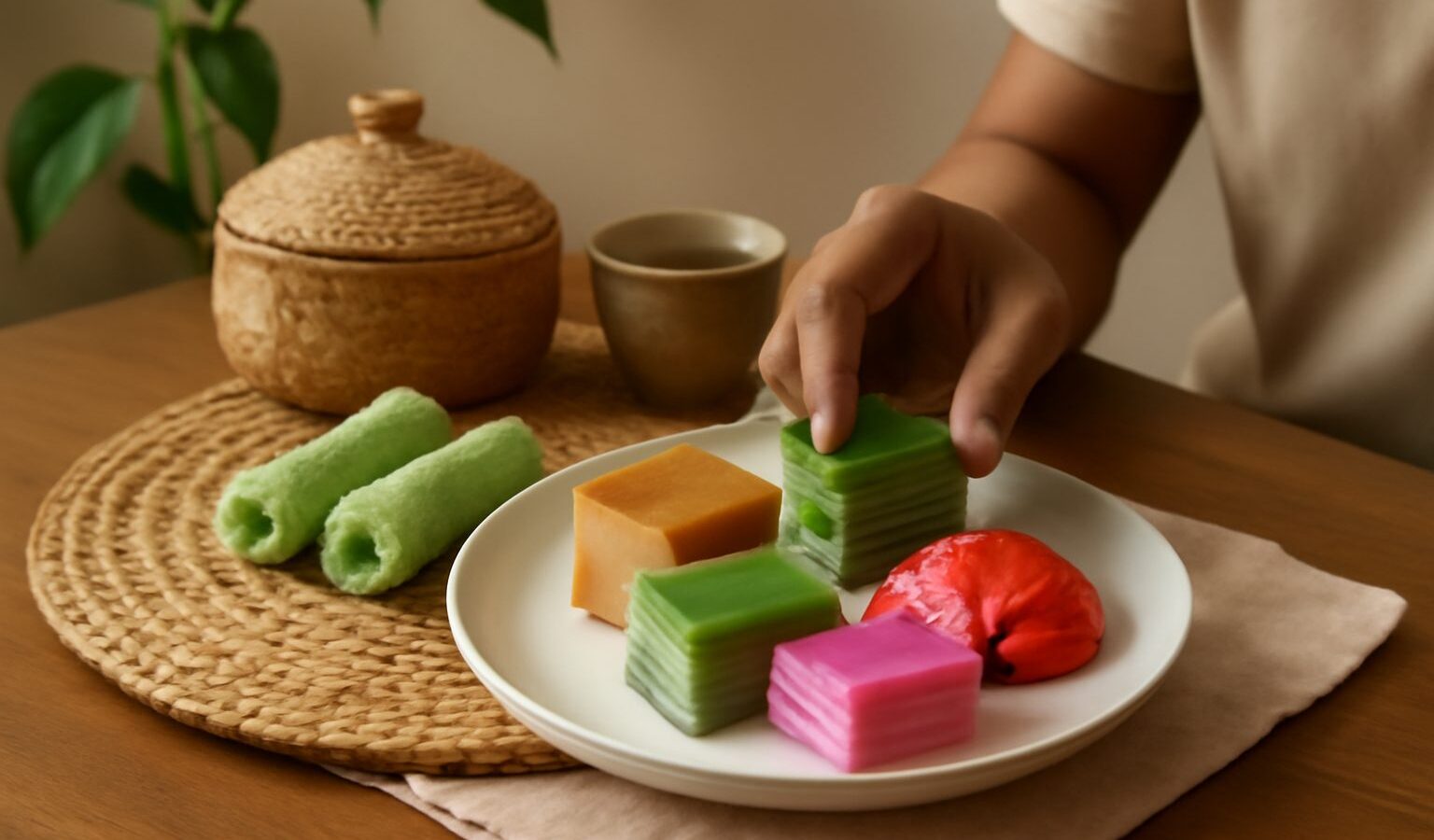
The traditional kueh heritage of Singapore is one of our most fragrant and colourful inheritances, carried down through Nyonya and Malay kitchens over many generations. These bite-sized cakes and sweets are far more than a snack. They are a record of trade, migration, and the way communities here have shared ingredients, techniques, and celebrations.
What We Mean by Kueh
Kueh, sometimes spelt kuih, is a broad family of steamed, baked, or fried cakes made from rice, glutinous rice, tapioca, sago, and coconut. Some are soft and glutinous, others crisp and layered. What unites them is a reliance on humble local ingredients transformed with patience and skill.
The word itself travelled with the region’s languages, and you will hear it spoken across Malay, Peranakan, and Hokkien-speaking households. In Singapore, kueh sits at the meeting point of these communities, which is exactly why the tray at a heritage stall looks so varied.
The Nyonya and Malay Threads
Two great traditions shape the kueh we know today. Nyonya kueh comes from the Peranakan community, descendants of early Chinese settlers who married into local Malay society. Their kitchens blended Chinese methods with Malay ingredients such as coconut milk, palm sugar, and pandan.
Malay kueh shares much of this larder but keeps its own repertoire and festive rhythm, especially around Hari Raya. Because the two traditions grew side by side, many kueh are claimed fondly by both, and the friendly overlap is part of the heritage rather than a dispute to settle.
Signature Kueh to Know
- Kueh lapis: a steamed layered cake, each thin layer set one at a time, a labour of love that can take an hour of careful steaming.
- Ondeh ondeh: pandan-scented glutinous balls filled with molten palm sugar and rolled in fresh coconut.
- Kueh salat or seri muka: a two-layer kueh with sticky rice below and a smooth pandan custard above.
- Ang ku kueh: a Hokkien-rooted red tortoise cake, moulded with auspicious motifs and shared at full-moon and birthday celebrations.
Colour Straight From the Garden
One of the most striking things about traditional kueh is that its colours come from nature, not a bottle. This is a defining part of the heritage and a point of quiet pride among makers.
Pandan leaves give a fresh green and a grassy perfume. The blue pea flower, steeped in water, tints glutinous rice a soft indigo, most famously in nasi kerabu and in blue-swirled kueh. Palm sugar, known as gula melaka, lends deep caramel browns and a smoky sweetness. Turmeric adds warm yellow, while beetroot and other roots can bring gentle reds and pinks.
| Natural source | Colour it gives | Kueh where you often see it |
|---|---|---|
| Pandan leaf | Green | Kueh salat, kueh ondeh ondeh |
| Blue pea flower | Blue | Pulut tai tai, blue-tinted rice kueh |
| Gula melaka | Caramel brown | Ondeh ondeh filling, kueh kosui |
| Turmeric | Yellow | Various steamed rice kueh |
| Cooked rice flour and coconut | White | Base of many layered kueh |
Kueh Through the Festive Year
Kueh is woven into the calendar. During Chinese New Year, Peranakan families prepare kueh bangkit, a melt-in-the-mouth coconut biscuit, and pineapple tarts glazed to a golden shine. Ang ku kueh appears at a baby’s first-month celebration and at ancestral offerings, its red colour signalling good fortune and its tortoise shape wishing long life.
For Hari Raya, Malay households lay out trays of kueh for visitors, from crisp kueh rose to layered kueh lapis. Weddings and full-moon parties across communities all call for their own spread. In this way kueh marks the passages of life, offered to guests as a sign of welcome and abundance.
The Craft and Its Keepers
Making kueh well is slow work. Coconut must be freshly grated and squeezed, pandan pounded or blended for its juice, and layers steamed one at a time. Moulds for ang ku kueh and kueh bangkit are often wooden heirlooms, their patterns worn smooth by decades of use.
Because the work is so demanding, the number of makers has thinned over the years. Yet a new generation of home bakers and small stalls has taken up the craft, drawn to its beauty and keen to keep natural methods alive. Heritage markets, wet-market corners, and family recipes passed hand to hand all help the tradition endure.
Tasting Kueh With Respect
If you are new to kueh, start simple. Buy a small assorted box from a trusted stall and notice the textures, from springy to crumbly. Ask the maker what each one is, as most are happy to share the story behind a favourite. Remember that a kueh you enjoy may be treasured by more than one community, and that shared affection is the point.
Reading a Kueh Tray
A well-stocked kueh tray tells a story if you know how to read it. Notice how the layered kueh are cut to show their patient bands of colour, a quiet boast of the maker’s skill. Look at how the glutinous pieces glisten with fresh coconut, a sign they were made that morning rather than left to sit.
Texture is the heart of the experience. Some kueh are firm and springy, meant to be bitten cleanly, while others are soft and yielding, best eaten in one gentle mouthful. The interplay of sweet palm sugar, salty coconut, and fragrant pandan is deliberate, balancing richness so that no single flavour overwhelms. Eating slowly, one small piece at a time, is the way these treats were always meant to be enjoyed.
Prices remain modest, which is part of the tradition’s warmth. Kueh was never a luxury reserved for the few but an everyday pleasure and a gift freely shared, and that spirit of generosity is worth keeping alive along with the recipes themselves.
A Living Inheritance
Traditional kueh heritage endures because it is generous by nature, meant to be made in batches and shared. Every green swirl of pandan and every dark ribbon of gula melaka carries the memory of grandmothers, festive mornings, and a Singapore built by many hands. To buy a piece, taste it slowly, and pass the tradition on is to keep that colourful inheritance alive for the next generation.
Explore more: Peranakan Culture in Singapore · Kampong Days in Singapore · Old Singapore Nostalgia