
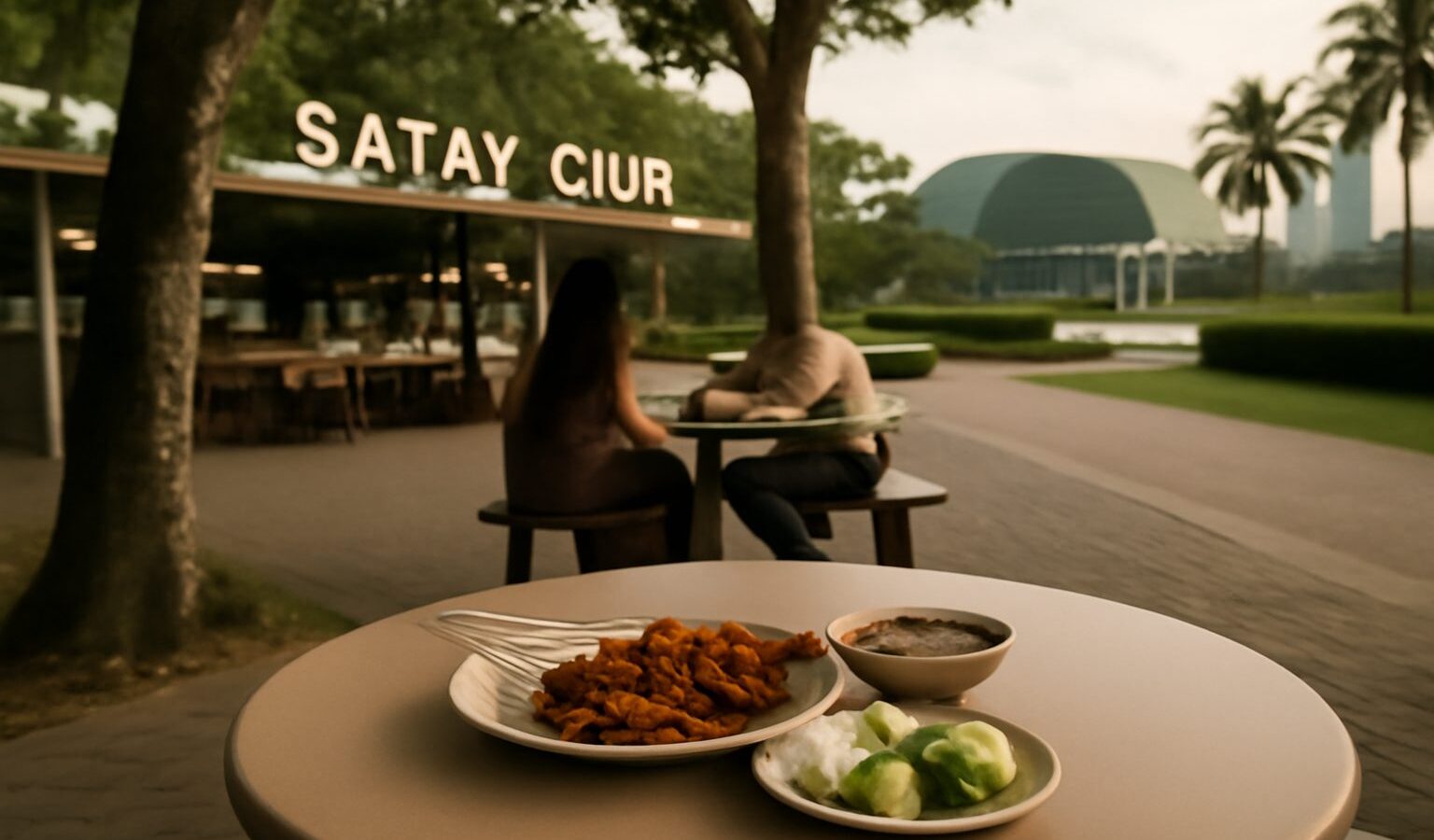
On warm evenings by the waterfront, the air near Esplanade Park once filled with fragrant smoke and the sizzle of skewers over glowing coals. This was the Satay Club Singapore, a famous open-air gathering of satay sellers that became one of the city’s most beloved eating spots. It was not a club in the formal sense, but a lively cluster of hawkers whose grilled meat, peanut sauce and cheerful bustle drew locals and visitors for generations. Though the stalls have long moved on, the Satay Club remains a warm and smoky memory in the story of Singapore’s hawker heritage.
What the Satay Club Was
The Satay Club took shape as an open-air hawker gathering near the Esplanade, along the waterfront strip by Queen Elizabeth Walk in the central district. Satay sellers, many of them skilled specialists in this single dish, set up their stalls together in the open evening air. Customers sat at simple tables while the hawkers fanned charcoal fires and grilled skewers of chicken, mutton and beef, serving them with cucumber, onion, pressed rice cakes and a rich, sweet and spicy peanut sauce.
Part of the magic lay in the setting. This was outdoor eating at its most atmospheric, under the open sky, with the sea breeze off the waterfront and the glow of many small fires. The sellers would often bring the food right to your table, a cheerful negotiation of how many sticks you wanted and of which meats. The smoke, the sizzle, the shouted orders and the shared tables all combined into an experience that was about far more than the food alone, though the food was very good indeed. The Satay Club sits proudly within the broader tale told in our history of hawker culture in Singapore.
Its Heyday, Its Memories and Its Social Role
For decades the Satay Club was a genuine institution. It was where families came for a treat, where friends gathered after work, and where visitors were taken to taste an authentic local favourite in a memorable open-air setting. Because it sat near the civic and commercial heart of the city, close to grand old buildings and the waterfront, it drew an easy mix of people from all walks of life. Office workers loosening their ties, families with excited children and tourists clutching cameras all shared the same long tables and the same clouds of fragrant smoke.
The memories people keep are wonderfully sensory. The smell of grilling meat carried on the evening air. The satisfying char on a well cooked skewer. The particular pleasure of dipping stick after stick into a communal bowl of peanut sauce. Counting up the empty skewers at the end to settle the bill. For many Singaporeans, a night at the Satay Club is bound up with a whole mood of the old city at dusk, relaxed, sociable and generous. That same feeling of unhurried evenings runs through much of old Singapore nostalgia.
The Satay Club also carried real cultural weight. Satay itself is a dish that crosses communities, enjoyed across the Malay, Chinese, Indian and other groups that make up Singapore, and the club was a place where this shared love played out nightly under the stars. It showcased hawker skill at its finest, the mastery of a single dish honed over years, and it became a symbol of the open-air, communal style of eating that Singapore holds dear.
What Happened to It and the Heritage That Lingers
Like many treasured open spaces in a fast changing city, the original Satay Club eventually gave way to redevelopment. As the waterfront and civic district were reshaped through the 1990s, the open-air site near Esplanade Park was cleared, and the famous gathering of stalls at that spot came to an end. For many who loved it, the closure marked the loss of a genuine landmark of everyday life, one measured not in architecture but in flavour, atmosphere and habit. It joined the long roll of much loved places gathered in our look at Singapore lost buildings and landmarks.
The story did not end entirely, though. Some of the spirit and some of the sellers found new homes, and the Satay Club name lived on in a relocated setting so that the tradition would not be forgotten. Satay remains one of the most cherished dishes on the island, still grilled over charcoal at hawker centres and food streets across the country. The particular romance of the original open-air site by the waterfront, however, belongs to memory now.
Esplanade Park itself endures as a green and historic space by the water, carrying its own layers of heritage from an earlier era. Strolling there today, an older Singaporean might pause and remember the evenings when this stretch smelled of charcoal and peanut sauce, and the tables were full of laughter and the clink of skewers. The Satay Club Singapore may be gone from its old ground, but the taste it stood for, and the easy communal joy of eating together in the open air, remain deeply woven into what the city loves about itself. To place it in the longer story of the nation, see our Singapore history timeline.