
Ask any overseas plant guide about humidity and you will read pages of advice on misting, humidifiers and pebble trays, all designed to fight dry indoor air. Here in the tropics, most of that worry is upside down. Understanding humidity for houseplants in Singapore starts with one liberating fact: our outdoor air is already warm and wet, often sitting around 70 to 90 per cent relative humidity all year. For the vast majority of leafy houseplants, that is close to perfect. Your real humidity problem is not the weather outside; it is the air-conditioning inside.
What Humidity Actually Means for Plants
Relative humidity is simply how much moisture the air is holding compared with how much it could hold at that temperature. Plants care about it because they constantly lose water through tiny pores on their leaves, a process called transpiration. When the surrounding air is moist, that loss is slow and comfortable. When the air is dry, leaves lose water faster than the roots can replace it, and the plant shows stress through crispy edges, browning tips and slowed growth.
Most popular foliage houseplants, from monsteras and pothos to calatheas and ferns, come from tropical rainforests. They evolved in exactly the kind of warm, humid, still-ish air that Singapore delivers for free. This is why so many imported plants that struggle in temperate flats grow with ease on a sheltered HDB corridor or balcony here. You are gardening inside their natural comfort zone, which is a genuine head start.
Why Air-Conditioning Is the Real Culprit
Here is the twist. The moment you switch on the aircon, you change the climate in that room completely. Air-conditioners cool a space by removing heat and, crucially, moisture. That is why there is a drain pipe dripping outside: the unit is pulling water out of your indoor air. A bedroom or office kept cool all day can fall to 40 or 50 per cent humidity, which feels lovely to us but reads as a mini dry season to a rainforest plant.
The plants most likely to suffer sit right in the airflow of a wall unit or under a strong ceiling vent. The constant cool draught both lowers humidity and physically dries the leaves, so you see brown tips creeping in even though the plant is watered correctly. The fix is often as simple as moving the pot. Nudge humidity-loving plants out of the direct blast of the aircon and towards a brighter, less draughty corner, or keep them in a room that is not air-conditioned around the clock.
Signs Your Plant Wants More Humidity
Before you buy anything, learn to read the plant, because dry air produces a fairly specific look. Crispy, papery brown tips and edges on otherwise green leaves are the classic signal, especially on thin-leaved plants like calatheas, marantas, ferns and some palms. New leaves that emerge small, or fail to unfurl fully, can also point to air that is too dry for a fussy species.
Do not confuse these signs with other problems, though. Whole yellowing lower leaves usually mean a watering issue, not humidity. Brown tips can also come from a build-up of salts if you always let the pot sit in old, mineral-heavy water, or from underwatering. As a rule, if only the very tips and edges are affected and the plant lives in an air-conditioned room, dry air is the likely cause.
Humidity at a Glance
| Situation | Humidity level | What it means for plants |
|---|---|---|
| Outdoors or open balcony | Very high, often 70 to 90% | Ideal for most tropical foliage |
| Naturally ventilated room | Comfortably moist | Fine for nearly all houseplants |
| Occasionally air-conditioned room | Moderate | Most plants cope well |
| All-day air-conditioned room | Can drop to 40 to 50% | Thin-leaved plants may crisp up |
| Directly in aircon draught | Dry and windy | Brown tips likely; move the plant |
Simple Ways to Raise Humidity Without Fuss
If you do have thirsty plants in a cool, dry room, you can lift the local humidity cheaply and sensibly. The single most effective trick is grouping. Cluster several plants together so they share the moisture they release through their leaves, creating a slightly more humid pocket of air around the whole cluster. It looks lush and it genuinely works.
A pebble tray is the next step: a shallow tray of pebbles topped up with a little water, with the pots resting on the stones above the waterline so the roots never sit wet. As the water evaporates it raises humidity right where the plant needs it. The one firm rule in Singapore is that this water must never be allowed to stagnate. Standing water is a breeding ground for Aedes mosquitoes, so refresh trays often, keep them clean, and follow NEA’s guidance on removing stagnant water. If a tray is too much bother, simply move the plant somewhere naturally moister, such as a bright bathroom or a sheltered corridor.
Why Misting Is Overrated Here
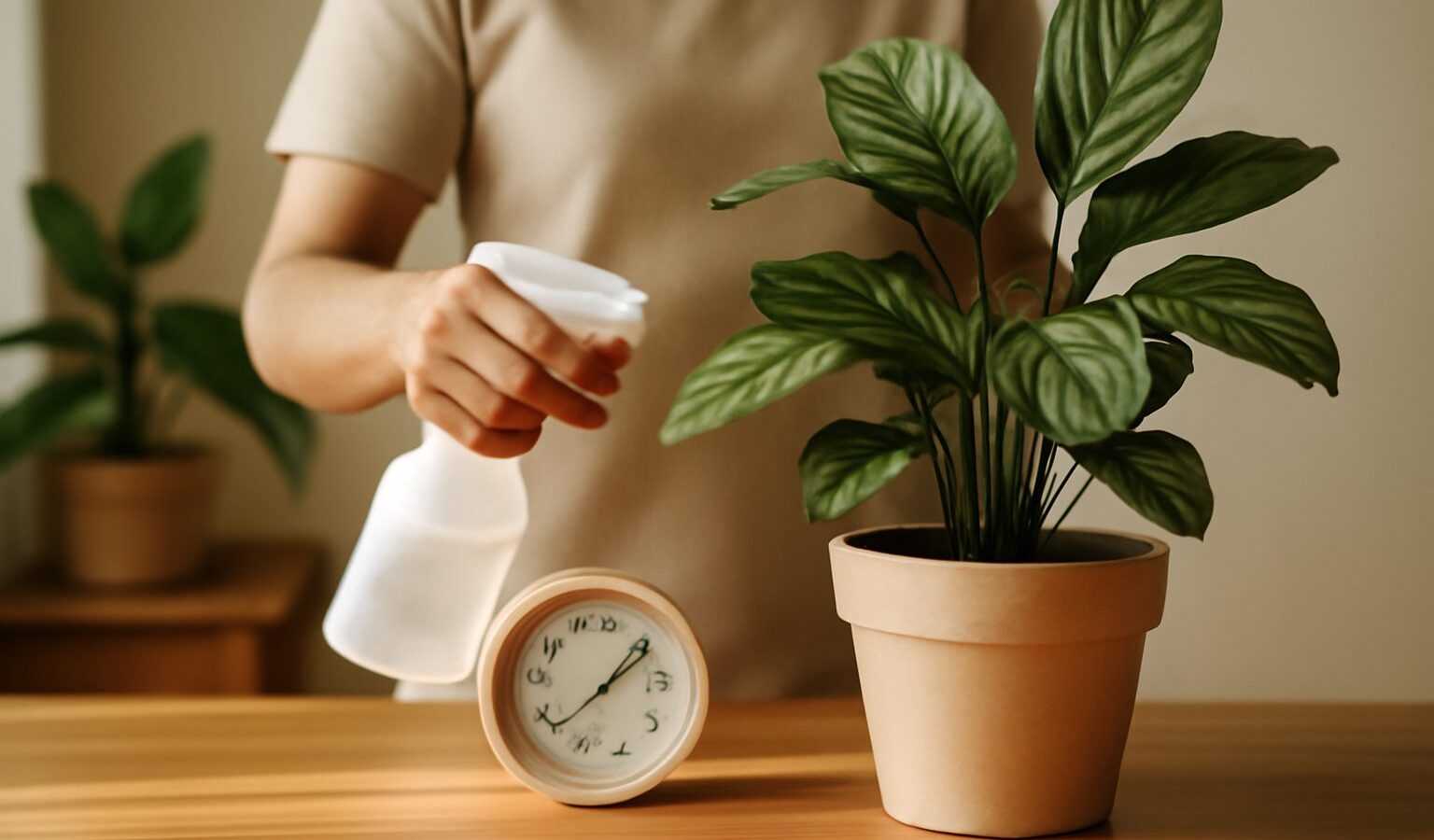
Misting is the advice everyone gives and almost nobody needs in the tropics. A quick spray raises humidity for only a few minutes before it evaporates, so it does little for the plant’s long-term comfort. Worse, in our already warm, damp climate, leaving leaves wet encourages fungal spots and bacterial problems, particularly on fuzzy-leaved plants and in still air. You are far more likely to spread disease than to solve a humidity problem.
If a plant truly needs more moisture in the air, grouping, a clean pebble tray or a better location will serve you far better than a spray bottle. Save misting for the rare job of gently rinsing dust off smooth leaves, and even then, do it in the morning so the foliage dries quickly. In short, respect the humidity you already have, watch out for the drying effect of aircon, and reach for the simplest fix first.
Explore more
Ready to put this into practice? Start with Grouping Plants to Boost Humidity, then read How to Water Plants in Singapore’s Heat so watering and humidity work together. For diagnosing crispy leaves, see Common Houseplant Problems and Fixes, and if you are just starting out, try A Beginner’s Guide to Houseplants.