
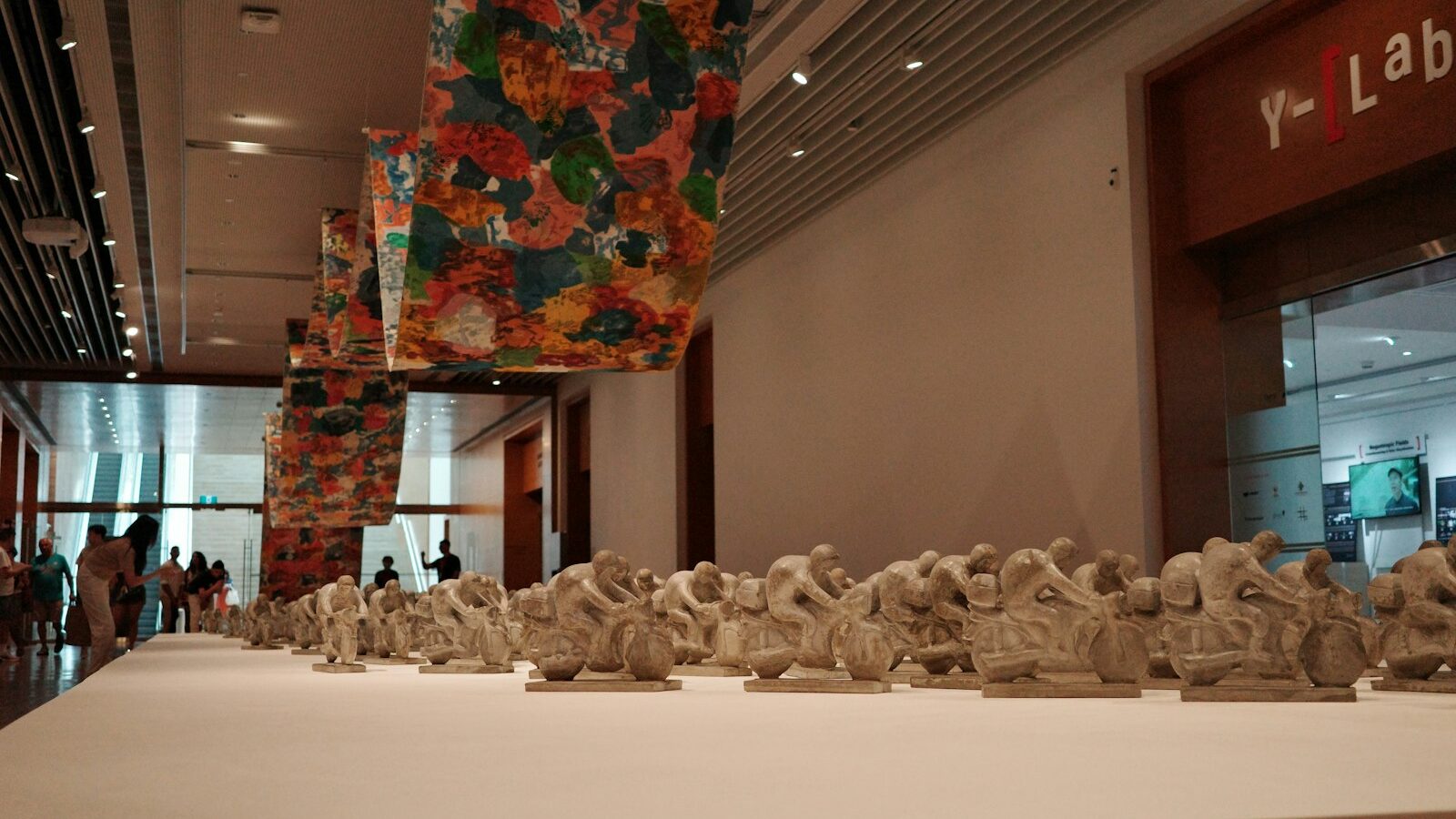
Paintings ask you to stand and look. Sculpture and installation art ask you to move, to walk around, to notice how the light changes and how the space feels. Understanding sculpture and its bolder cousin, installation art, is really about learning to look with your whole body rather than just your eyes. Once you do, a whole dimension of art opens up.
Why Three Dimensions Change Everything
A painting shows you one fixed view that the artist chose. A sculpture has no single correct viewpoint. It changes as you circle it, revealing new profiles, hidden hollows, and shifting shadows. This is the first and most important habit to build: never judge a sculpture from one spot. Walk around it. The back is often as considered as the front, and the most interesting angle is rarely the obvious one.
Because sculpture occupies real space, it also relates to your body in a way flat art cannot. A towering bronze can make you feel small. A tiny carved figure invites you to lean in close. Notice how a work makes you position yourself, since that physical response is part of its meaning.
What to Look For in a Sculpture
You do not need training to look well. A handful of questions unlocks almost any three dimensional work.
- Material. Is it marble, bronze, wood, steel, clay, or something unexpected? Each material carries a mood. Marble feels timeless and cool, wood feels warm and living, steel feels industrial and strong.
- Surface. Is it polished smooth or rough and gouged? Run your eyes over the texture. Smooth surfaces glide the light, while rough ones trap shadow and show the maker’s hand.
- Mass and space. Notice not just the solid parts but the gaps. The empty spaces a sculpture carves out, called negative space, are as designed as the metal or stone.
- Weight and balance. Does the figure feel heavy and grounded, or does it seem to float, twist, or reach? Sculptors work hard to suggest movement in a still object.
- Light. Move around and watch how light pools and slides. In outdoor works, the piece changes completely from morning to evening.
From Object to Environment: Installation Art
Installation art takes the next step. Instead of an object you look at, it creates an environment you step into. The whole room, its light, sound, smell, and your movement through it become the artwork. You are not a viewer standing outside. You are inside the work, and your experience is the point.
This can feel strange at first. There may be nothing to admire on a pedestal. Instead, ask how the space makes you feel. Does it feel enclosing or open, calm or unsettling, playful or solemn? Installation art is often designed to shift your mood or make you newly aware of something ordinary, like your own footsteps or the colour of light.
Here is a simple way to see how these forms differ.
| Form | You are | Key experience | How to engage |
|---|---|---|---|
| Painting | An observer | Looking at a surface | Stand and look closely |
| Sculpture | A mover | Walking around an object | Circle it, change your angle |
| Installation | A participant | Entering a space | Move through, notice your senses |
| Public art | A passer-by | Meeting art in daily life | Pause, look up, return often |
Public Sculpture in the City
You do not need a gallery to enjoy sculpture. Singapore’s streets, parks, and waterfronts hold many works that most people walk past without a glance. Public sculpture rewards the habit of looking up and slowing down. A figure by the river, an abstract form outside an office tower, a piece tucked into a park: each was placed there on purpose.
Try this. Next time you pass a familiar public sculpture, stop for two minutes. Walk to the other side. Notice what material it is made of and how it sits against the sky or the buildings behind it. Works you have ignored for years can suddenly come alive.
Can You Touch It?
A common question, and the answer is usually no. Most sculptures, especially older or delicate ones, must not be touched, since oils from our hands damage surfaces over time. Always follow the signs and any guidance from staff. Some contemporary and interactive installations are designed to be touched or walked through, and these will make it clear. When in doubt, look with your eyes and keep your hands to yourself.
Giving Immersive Work a Chance
Immersive and installation art can divide people. Some find it thrilling, others feel there is nothing to see. If you are in the second camp, try lowering your expectations of what art should be. You are not there to find a beautiful object. You are there to have an experience and to notice your own response.
Spend longer than feels natural. Immersive works often unfold slowly. A light might shift, a sound might build, your eyes might adjust. Stay a while, breathe, and let the space work on you. Read any wall text afterwards to understand what the artist intended, then decide for yourself whether it succeeded.
A Few Encouraging Habits
- Move deliberately. The single best thing you can do with sculpture is walk around it. Front, side, back, and from below if you can.
- Look at the base. How a sculpture meets the ground often tells you about its balance and intent.
- Notice your body. Do you want to step back, lean in, or look up? That instinct is information.
- Give installations time. They reward patience more than a quick glance ever could.
Three dimensional and immersive art is not harder than painting. It simply asks for a different kind of attention, one that involves your feet as much as your eyes. Once you start walking around things and stepping inside them, you will find a richer, more physical way of enjoying art that stays with you long after you leave.
Explore more: How to Appreciate Visual Art · Contemporary Art in Singapore · Art Galleries in Singapore