

Knowing exactly when to water is the skill that separates thriving plants from struggling ones, and a simple probe can take a lot of the guesswork out of it. A soil moisture meter Singapore plant owners can pick up cheaply is a handy tool that reads how damp the soil is deep down where the roots live, rather than just at the surface. This is general guidance for home growers, so treat the meter as a helper rather than an infallible authority.
Watering is genuinely tricky in our climate. Surfaces dry out fast under the sun and breeze, tempting you to water again, while the soil a few centimetres down can still be soaking wet from the last downpour. Overwatering, which quietly rots more houseplants than anything else, often comes from watering to a schedule instead of to the plant’s actual need. A moisture meter, used sensibly, helps you water the plant in front of you.
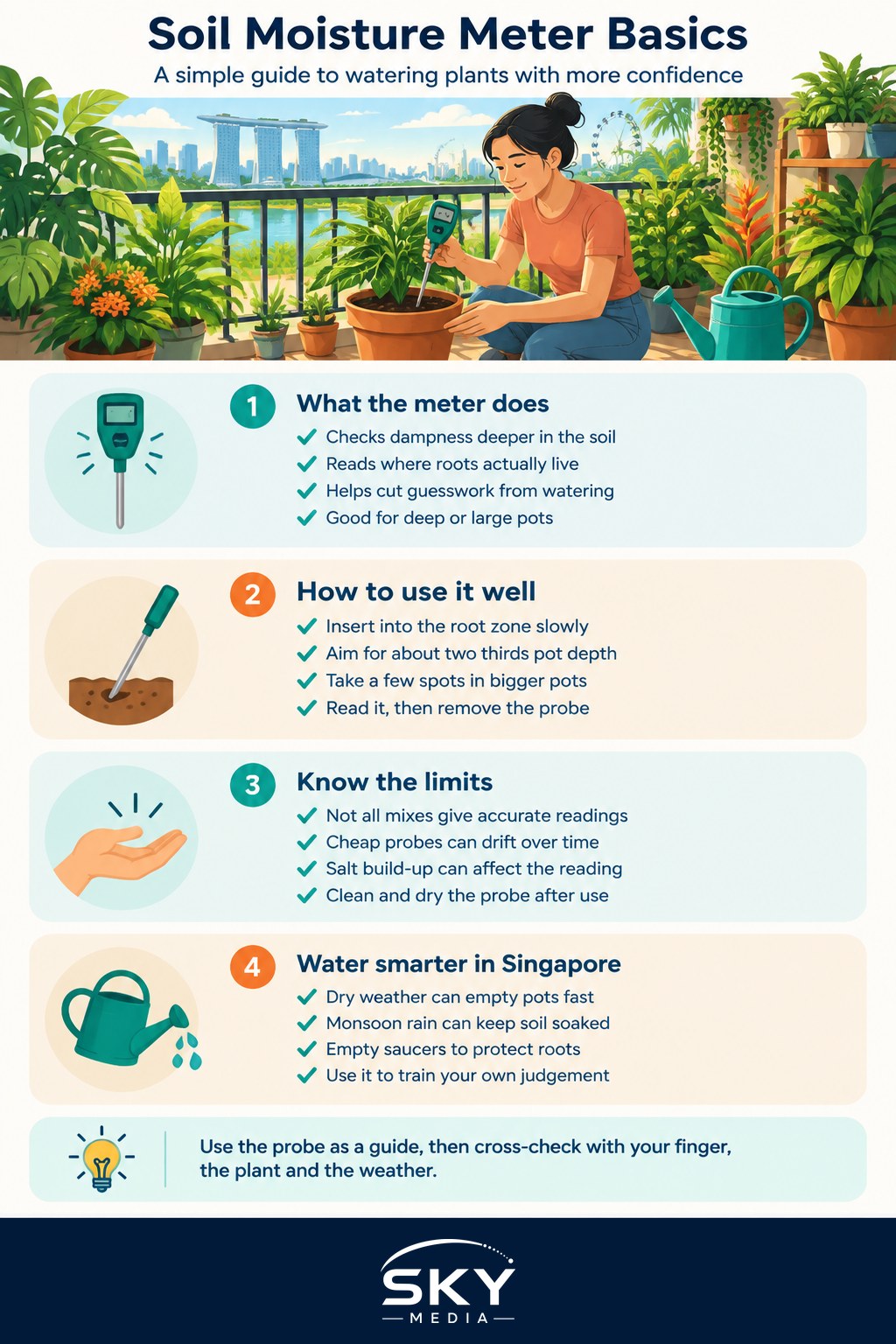
How a Soil Moisture Meter Works
Most home meters are inexpensive, battery-free probes. You push the metal prong into the soil, and a dial or simple display swings to a reading, usually on a scale from dry to moist to wet, or a number from one to ten. The probe responds to how well the soil conducts, which relates to how much water it holds. Some fancier meters also read light and pH, but the moisture function is the one people use daily.
The great advantage is depth. Your finger can only feel the top few centimetres, but a probe reaches down into the root zone, where the reading actually matters. That is especially useful in a deep or large pot, where the surface tells you almost nothing about conditions further down.
Using the Meter Properly
Getting a reliable reading takes a little technique.
- Push it into the root zone. Insert the probe slowly to about two thirds of the pot’s depth, near the roots but not jammed against the base. For a big pot, take a reading in two or three spots, as moisture is rarely even.
- Read it straight away. The dial usually settles within a few seconds. Note the reading, then remove the probe.
- Wipe it clean and dry. Always clean the metal probe after use and store it dry. Left dirty or damp, the metal corrodes and readings drift.
- Do not leave it in the soil. These meters are for spot checks, not permanent monitoring. Constant contact with damp soil shortens their life.
As a rough guide, water most plants when the meter reads towards the dry end, wait when it reads moist, and hold off entirely when it reads wet. But the ideal point varies by plant, which is where knowing your plant matters.
| Plant type | Water when meter reads |
|---|---|
| Succulents and cacti | Dry, right at the low end |
| Most houseplants and herbs | Low moist, as it approaches dry |
| Ferns, calatheas, moisture lovers | Moist, never let it fall to dry |
| Seedlings and young plants | Consistently low moist, never bone dry |
| Orchids in bark | Meters are unreliable here; check by weight and feel |
The Limits of a Moisture Meter
For all its usefulness, a moisture meter is not a magic wand, and it pays to know where it falls short. Cheap probes can be inaccurate, and readings drift as the metal ages or corrodes. Very loose, chunky or bark-based mixes can fool a meter into reading drier than the plant actually feels, because the probe is not in good contact with the material. Salt build-up from fertiliser can also throw a reading off. Two meters pushed into the same pot may even disagree.
This is why the meter should never be your only tool. The oldest and most reliable test is still your own finger. Push it into the soil to the second knuckle, and feel for yourself whether the mix is damp, cool and clinging, or dry and crumbly. Your finger costs nothing, never needs a battery and gives an honest answer.
Other simple checks work alongside the meter too. Lifting a pot tells you a lot, as a dry pot is noticeably lighter than a freshly watered one, and with practice you can judge watering by weight alone. The look of the plant matters as well, since drooping, dull or curling leaves are signs worth reading in context. Use the meter to confirm what your finger and your eyes are already telling you, and you will rarely go wrong.
Watering Wisely in Our Climate
A meter is most valuable in Singapore precisely because our conditions are so changeable. During a stretch of hot, dry weather, pots on a sunny balcony can dry through completely in a day, and the meter will confirm they need water. But during the monsoon, when rain falls day after day, the same pots can stay wet for a week or more, and the meter helps you resist the urge to water something that is already soaked.
Indoor plants under air-conditioning behave differently again, drying slowly in the still, cool air, and here the meter helps you avoid the classic mistake of overwatering a plant that simply is not using much water. Whatever the plant, always tip away any water that collects in the saucer, both to protect the roots and to deny mosquitoes a place to breed.
A meter is also a wonderful teaching tool for newer gardeners. By checking the reading and then feeling the soil with your finger, you slowly calibrate your own senses, learning what a plant that needs watering actually feels and weighs like. After a few weeks of cross-checking, many people find they barely need the probe at all, because they have trained themselves to judge moisture accurately by hand. In that sense the meter is a set of training wheels that quietly makes you a better waterer.
Use the probe as a guide, cross-check with your finger, and pay attention to the weather and your plant. Do that, and watering stops being a source of anxiety and becomes second nature.
Explore more
How to Water Plants in Singapore’s Heat
Understanding Soil and Potting Mix
How to Repot a Houseplant
Making Your Own Potting Mix
Frequently Asked Questions
Is a cheap soil moisture meter worth buying? It can be a helpful learning aid if you treat it as a guide. Cheap probes can be inaccurate and drift as the metal ages, so cross-check with your finger and the weight of the pot. Many people find they need it less once they have learned the feel of the soil.
Is there a free alternative to a moisture meter? Yes. Push a clean wooden chopstick or skewer deep into the pot, leave it a few moments and pull it out. Damp soil clings to it and darkens the wood, while a dry stick comes out clean. Your finger and the weight of the pot also work well.
What if the meter reads wet but my plant is drooping? Drooping with wet soil often points to waterlogged roots rather than thirst, so do not water more. Check drainage, empty the saucer and let the mix dry. If roots smell or look mushy, the plant may need repotting into fresh, airy mix.
Why do two meters give different readings in the same pot? Cheap probes vary, and a reading depends on contact with the soil, salts from fertiliser and the age of the metal. Loose or chunky mixes can read drier than they feel. Use the readings as a trend, and trust your finger when they disagree.
Can I use a moisture meter in a garden bed or large planter? Yes, take readings in several spots and at root depth, since moisture is rarely even in big containers or beds. Clean the probe after each use. In heavy clay or stony ground it may be harder to push in, so do not force it.