

Among the festivals that colour Singapore’s diverse religious calendar, Vaisakhi holds deep significance for the Sikh community. It is a joyful occasion that marks both the arrival of a new year and one of the most important moments in Sikh history, the founding of the Khalsa. For Sikhs in Singapore, Vaisakhi Singapore is a time of prayer, remembrance and communal celebration, observed with devotion at the gurdwaras and shared warmly with friends and neighbours. This guide offers a respectful introduction to the festival, its meaning and the way it is kept here.
Vaisakhi is generally observed in the middle of April, though because it follows a traditional calendar the precise date is best confirmed each year through the gurdwaras and Sikh community sources. What remains constant is the festival’s twofold character, joining the sense of seasonal renewal with the commemoration of a defining event in the story of the faith.
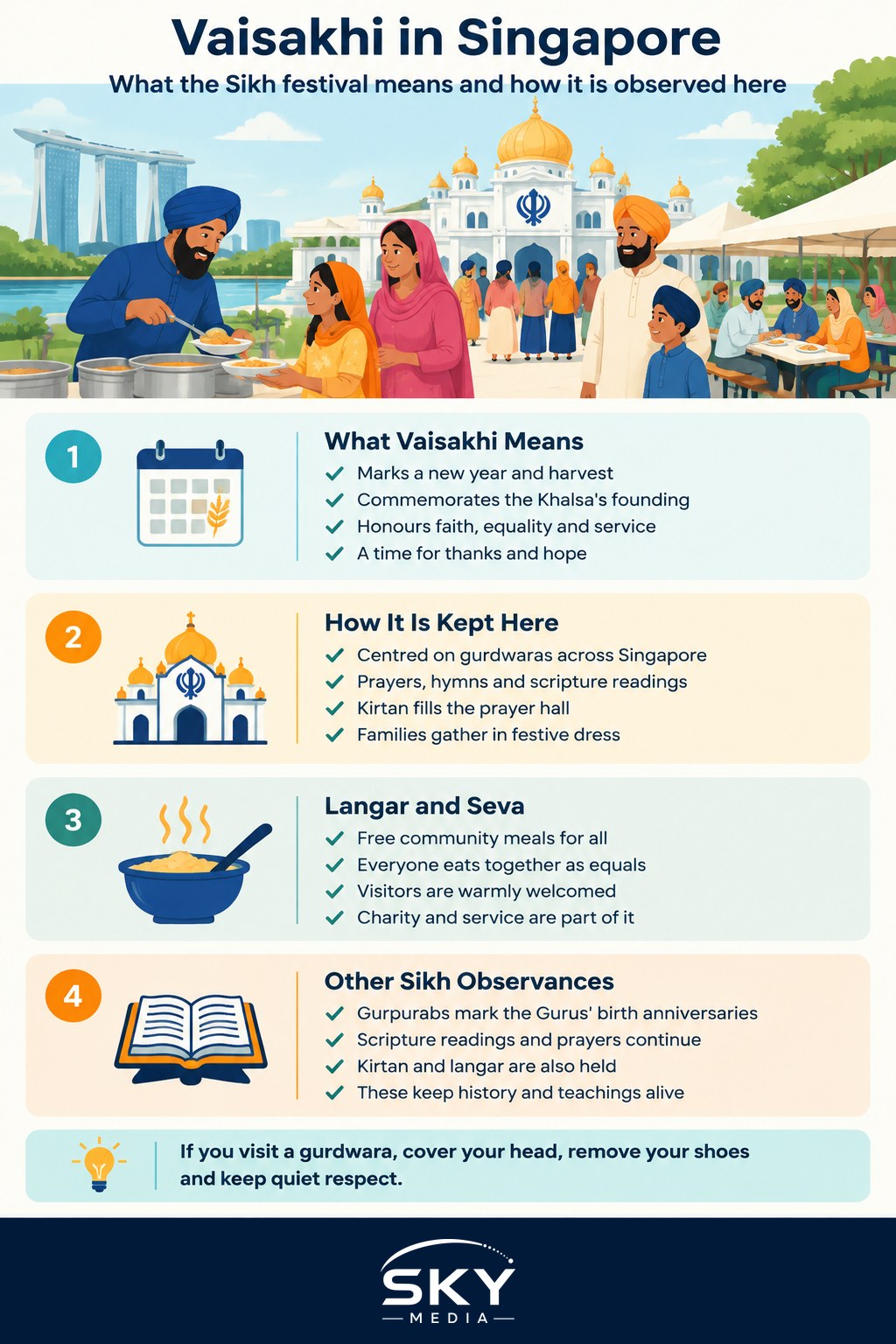
The Meaning of Vaisakhi
Vaisakhi has long been observed as a spring festival associated with the harvest in the Punjab region, a time of thanksgiving and new beginnings. For the Sikh community, however, it carries an added and profound significance. It commemorates the founding of the Khalsa by Guru Gobind Singh, the tenth of the Sikh Gurus. On this occasion the Guru is remembered for establishing the collective body of committed Sikhs and for setting out the ideals of faith, equality, courage and service that continue to guide the community today.
This founding moment is central to Sikh identity. It affirmed the equality of all people, the importance of living an honest and disciplined life, and the duty to stand up for justice and to serve others selflessly. When Sikhs gather at Vaisakhi, they reflect on these values and rededicate themselves to living by them. The festival is therefore both a celebration and a solemn remembrance, blending joy with a renewed sense of purpose.
Because Vaisakhi also marks a new year and a harvest, it carries an atmosphere of gratitude and hope. It is a moment to give thanks for what has passed and to look forward with optimism, and this cheerful, generous spirit runs through all the celebrations.
How Vaisakhi Is Celebrated in Singapore
In Singapore, Vaisakhi is centred on the gurdwaras, the Sikh places of worship. On the day of the festival the gurdwaras are beautifully prepared, and the community gathers for prayers, hymns and readings from the Guru Granth Sahib, the Sikh holy scripture. Devotional music, known as kirtan, fills the prayer hall, and the shared act of worship brings the community together in a mood of reverence and joy. Families dress in fine clothing, and the day has a festive, welcoming feel.
A cherished part of any gurdwara gathering, and especially of Vaisakhi, is the langar, the free community kitchen. Here a meal is prepared and served to all who come, regardless of background, faith or standing, and everyone sits together as equals to eat. The langar expresses the core Sikh values of equality, humility and service, and it is one of the most beautiful and inclusive traditions of the faith. Visitors are warmly welcomed to share in the meal, and doing so is a lovely way to experience Sikh hospitality first hand.
Vaisakhi is also a time of generosity and service to the wider community. In keeping with the Sikh emphasis on selfless service, or seva, members often take part in charitable acts and community work around the festival. The overall spirit is one of openness, with the doors of the gurdwara wide to all who wish to learn, to pray or simply to share in the celebration.
Where and How the Community Observes It
The Sikh community in Singapore, though relatively small, is well established and maintains several gurdwaras across the island, including the historic Central Sikh Temple. During Vaisakhi these gurdwaras become the focal points of celebration, drawing families and visitors for prayer, kirtan and the shared langar meal. Anyone wishing to observe is generally welcome, provided they follow the customs of the gurdwara, which include covering the head, removing shoes before entering the prayer hall and behaving with quiet respect.
Beyond Vaisakhi, the Sikh community observes other important occasions through the year, including the birth anniversaries of the Gurus, known as Gurpurabs. These are marked by continuous readings of the scripture, prayers, kirtan and langar, and they reinforce the community’s connection to its history and teachings. Together these observances form part of the broader life of the Sikh and other smaller communities in Singapore that enrich the nation’s cultural fabric.
Vaisakhi is a fine example of the religious harmony and festivals that characterise Singapore, where communities of many faiths celebrate side by side and often welcome one another to their gatherings. For those keen to explore further, the Singapore festivals guide offers a wider view of the celebrations kept across the island through the year.
To take part in Vaisakhi in Singapore, whether by observing the prayers or sharing in the langar, is to encounter the warmth, equality and generosity that lie at the heart of the Sikh tradition. In its blend of thanksgiving, remembrance and open hearted celebration, the festival offers a meaningful window into a faith that has long been part of the Singapore story.
Frequently Asked Questions
What is langar and can anyone eat there? Langar is the free community kitchen at the gurdwara, where a meal is served to all who come regardless of background, faith or standing, and everyone sits together as equals. Visitors are warmly welcomed to share in it.
What should I wear to a gurdwara? Cover your head, remove your shoes before entering the prayer hall and dress modestly. Behave with quiet respect. Follow the guidance of those present, and ask if you are unsure about any custom.
What is the Khalsa? It is the collective body of committed Sikhs founded by Guru Gobind Singh, the tenth Sikh Guru. It set out ideals of faith, equality, courage and service, and Vaisakhi commemorates its founding as well as marking the new year and harvest.
What is kirtan? Kirtan is devotional music, filling the prayer hall with hymns during worship. Together with prayers and readings from the Guru Granth Sahib, it brings the community together in a mood of reverence and joy.
What are Gurpurabs? They are the birth anniversaries of the Sikh Gurus, observed through continuous readings of the scripture, prayers, kirtan and langar. They are separate occasions from Vaisakhi and reinforce the community’s connection to its history and teachings.
Further reading: Holi in Singapore: How the Festival of Colours Is Celebrated · Silat Road Sikh Temple · Guru Nanak Gurpurab in Singapore