
Most Singapore homes run on more gadgets than the original socket layout ever planned for. A HDB flat built decades ago might have two sockets in the living room, yet today that corner hosts a TV, a router, a game console, a soundbar, a fan and a phone charger. Extension cords and multi-plug adaptors fill the gap, and used properly they are perfectly fine. Used carelessly, they are a common factor in household electrical fires. This guide covers multi plug adaptor safety for adults: how to avoid overloading, how to check the Safety Mark, and which heat warning signs mean you should unplug right away.
Know Your Adaptor: Types and What They Are For
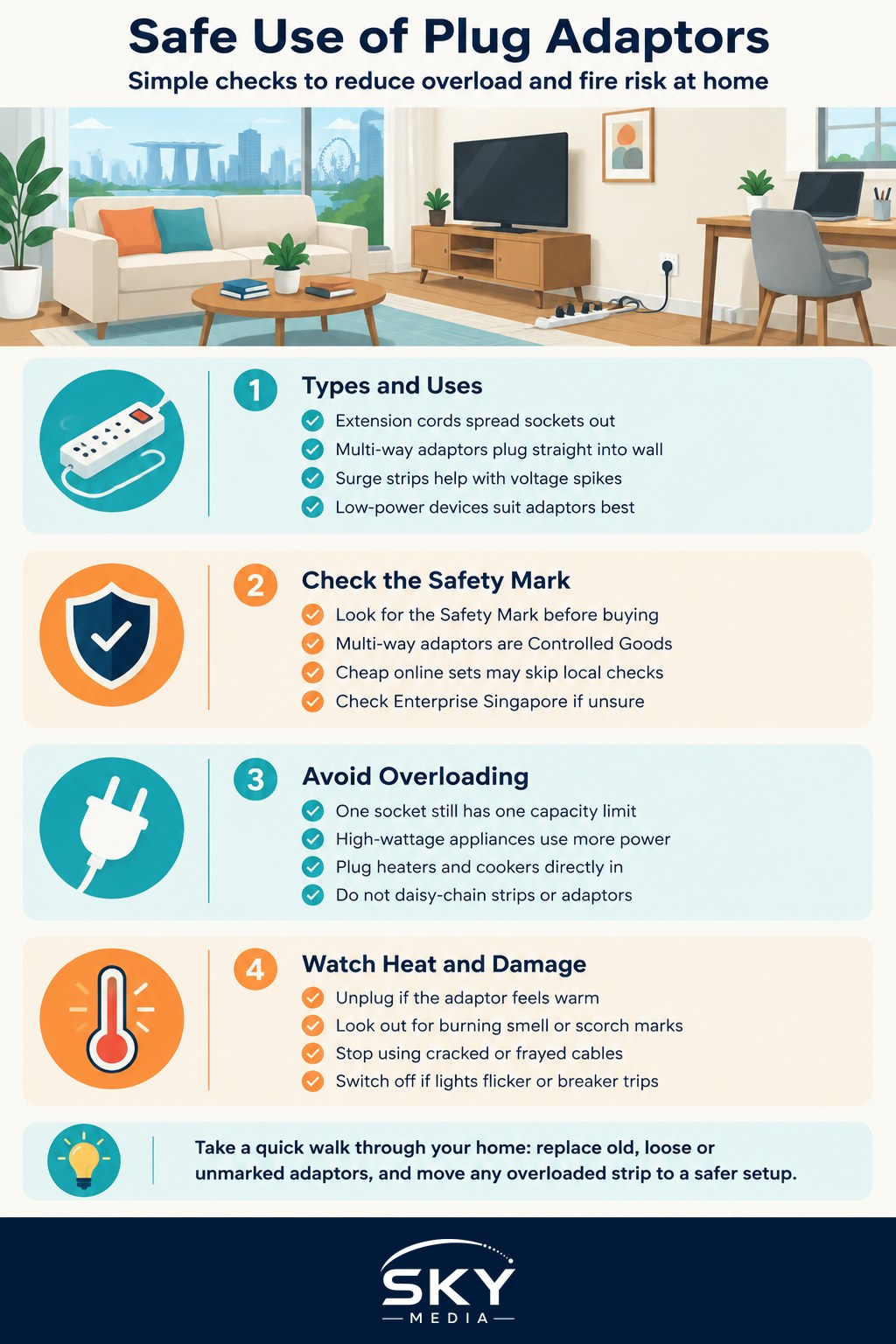
Singapore uses the three-pin Type G plug and a 230V supply, the same system as the UK. The products you will find in hardware shops, supermarkets and online fall into a few groups:
- Extension cord sets (power strips): a length of cable ending in a block of several sockets, sometimes with individual switches. Good for spreading out a desk or TV setup.
- Multi-way adaptors: a compact block that plugs straight into the wall and gives you two or three sockets. Convenient, but they put weight and leverage on the wall socket.
- Surge-protected strips: extension sets with built-in protection against voltage spikes. Useful for computers and AV equipment, but surge protection does not stop overloading.
If you brought appliances from overseas, our guide to using your China appliances here, plugs and voltage explains why a plug adaptor is not the same as a voltage converter.
Check for the Safety Mark Before You Buy
In Singapore, certain household electrical products are classed as Controlled Goods under the Consumer Protection (Safety Requirements) Registration Scheme, which is overseen by the Consumer Product Safety Office under Enterprise Singapore. Multi-way adaptors and extension cord sets are among the product types covered. Controlled Goods must be registered and carry the Safety Mark before they can be sold locally.
What this means for you:
- Look for the Safety Mark label on the product or its packaging before buying.
- Be extra careful with very cheap listings on online marketplaces, especially those shipped from overseas. Products sold through these channels may not have gone through local registration.
- If in doubt, Enterprise Singapore’s consumer product safety website lets you check product registration and read safety alerts and recalls. The list of Controlled Goods can be updated, so check the current version there.
How Overloading Happens and How to Avoid It
Every socket, adaptor and extension cord has a maximum current it can safely carry. A standard Singapore wall socket and most adaptors are commonly rated at 13A, but always read the rating printed on your own product, as some extension sets are rated lower. The important point is that adding more sockets does not add more capacity. A four-way strip plugged into one wall socket still shares the limit of that one socket.
To estimate the load, look at the wattage on each appliance label. High-wattage items add up quickly. Appliances that heat or cool tend to draw the most, such as:
- kettles, air fryers, ovens and induction cookers
- irons, hair dryers and clothes steamers
- portable heaters, portable air conditioners and dehumidifiers
As a rule of thumb, plug each of these directly into its own wall socket rather than into an adaptor, and never run two of them from the same strip at the same time. Low-power items such as phone chargers, routers, lamps and TV boxes are what adaptors are best suited for.
Other habits that prevent overloading:
- Do not daisy-chain. Plugging one extension cord or adaptor into another multiplies the risk and makes it hard to know the total load.
- Fully unwind cable reels. A coiled cable carrying a heavy load can trap heat and overheat. Unroll it completely if it is in use.
- Switch off and unplug when not in use, particularly for heating appliances and chargers left on overnight.
Safe Habits Compared: Do and Don’t
| Situation | Do | Don’t |
|---|---|---|
| Running a kettle or air fryer | Plug directly into a wall socket | Plug into a multi-way adaptor shared with other devices |
| Need more sockets at a desk | Use one Safety Mark extension strip for low-power devices | Daisy-chain a second strip off the first |
| Cable needs to cross a room | Run it along the wall, secured with cable clips | Run it under rugs, mats or through doorways where it gets pinched |
| Adaptor feels loose in the socket | Replace it, or use a corded strip so weight is off the socket | Wedge it with tape or folded paper |
| Kitchen or bathroom area | Keep plugs and strips well away from water and steam | Rest a strip on a wet counter or the floor near a sink |
Heat Warning Signs: When to Unplug Immediately
Overheating usually gives warnings before anything worse happens. Check hidden adaptors behind cabinets and desks from time to time. Unplug and stop using an adaptor or cord if you notice:
- the plug, adaptor or socket is warm or hot to the touch
- a burning, melting plastic or “fishy” smell
- brown or black scorch marks around the pins or socket face
- melted, warped or discoloured plastic
- buzzing, crackling or sparking when you plug in
- lights flickering or the circuit breaker tripping when a device is switched on
- a cable that is cracked, frayed, flattened or has exposed inner wires
If the wall socket itself shows scorching or the breaker trips repeatedly, stop using that point and have it checked by a licensed electrician. The Energy Market Authority lists licensed electrical workers.
Placement, Ventilation and Everyday Care
Where you put an adaptor matters as much as what you plug into it. Singapore’s warm, humid climate means heat builds up behind furniture quickly.
- Leave space for air. Do not bury a power strip under cushions, clothes, bedding or piles of paper.
- Keep it off the floor where it can get wet, such as near the washing machine, aircon drip or the kitchen floor during mopping. Mounting a strip on the side of a desk or wall keeps it dry and visible.
- Avoid heavy adaptors hanging off a wall socket. A bulky adaptor with chargers attached can pull the plug partially out, leaving a poor contact that heats up. A corded strip is safer in that case.
- Retire old products. If an adaptor is very old, loose or lacks the Safety Mark, replace it.
If you are considering smart plugs to switch devices on schedules, see our guide to smart plugs and home automation routines. The same overloading rules apply to them: a smart plug is not a way to run a heater from a crowded strip. And if anyone in your household charges an e-scooter or PMD battery, read how to store an e-scooter battery safely, as charging those batteries from overloaded adaptors is a particular risk.
What to Do If an Adaptor Starts Smoking or Catches Fire
Stay calm and act quickly:
- If it is safe to reach, switch off the power at the wall or at your home’s main switch on the distribution board.
- Never pour water on an electrical fire. If you have a suitable fire extinguisher and the fire is very small, use it only if you know how and have a clear exit.
- If the fire is spreading or there is heavy smoke, get everyone out, close the door behind you and call 995 for SCDF.
- Do not reuse anything that has scorched or melted, and have the socket checked by a licensed electrician before using it again.
SCDF publishes home fire safety advice worth reading once, before you ever need it.
Good multi plug adaptor safety comes down to a few habits: Safety Mark products, no overloading or daisy-chaining, and regular checks for heat. Spend ten minutes walking through your home, and you will likely find at least one strip worth moving or replacing.
Explore more: Creating a Multi-Generational Home in Singapore
Further reading: Hanging Christmas Lights Safely at Home: Electrical Safety and HDB Rules · How to Choose a Step Ladder for Your Home and Use It Safely