
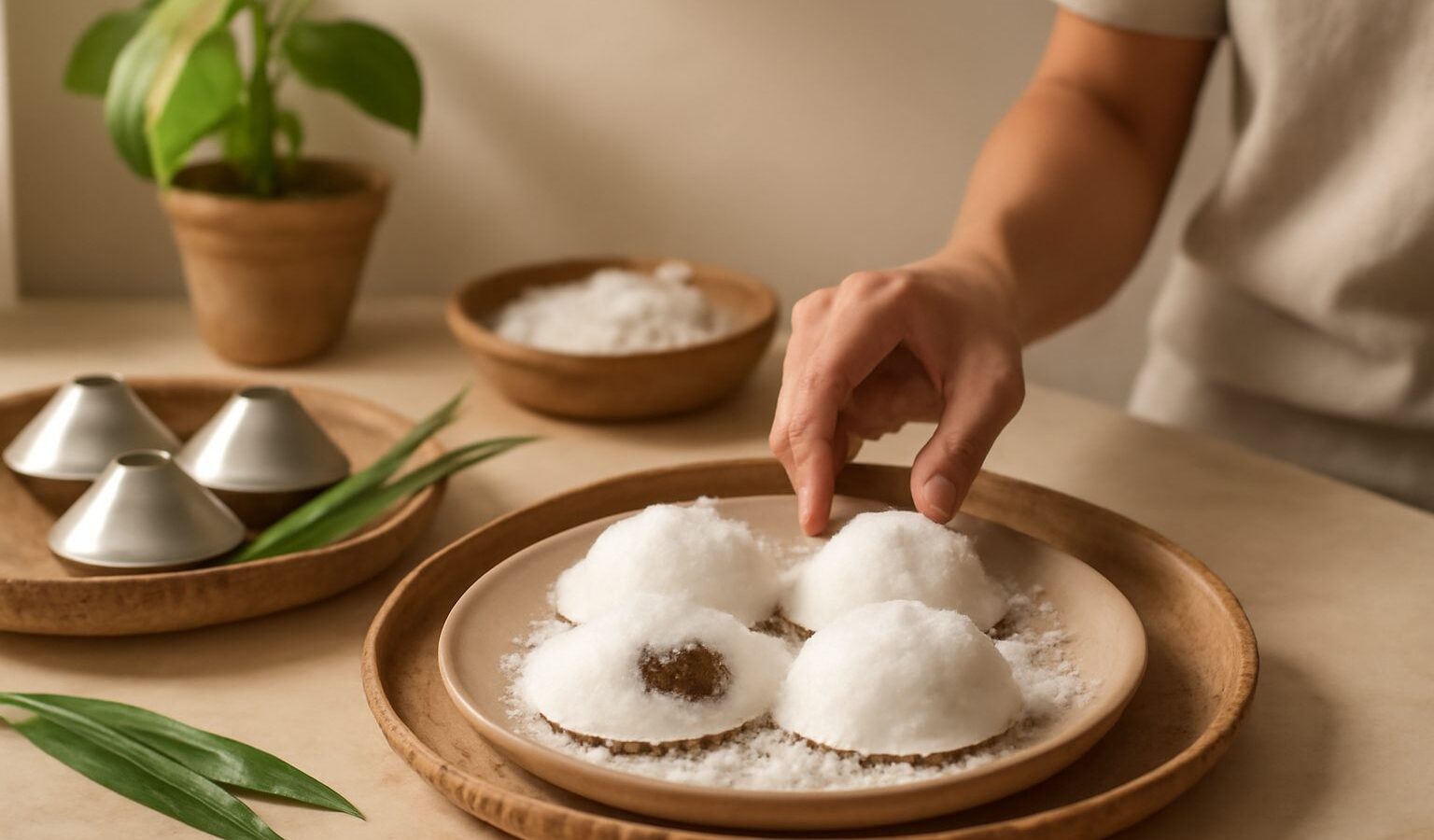
Few Singapore snacks reward patience quite like putu piring. You spot the stall by the plume of steam and the small queue, then you wait while soft discs of rice flour are shaped by hand, filled with dark palm sugar and steamed to order. What lands in your hand minutes later is warm, pillowy and fragrant, with a molten gula melaka centre that oozes the moment you bite in. This putu piring guide explains what the dish is, how it is made, how it differs from its cousins, and how to enjoy it at its best.
What Putu Piring Actually Is
Putu piring is a traditional Malay steamed rice cake, round and slightly domed, dusted with grated coconut and served warm. The name loosely describes its form: a soft, saucer shaped cake made from finely ground rice flour. The dough is barely sweet on its own, which is deliberate, because the sweetness lives in the middle. Tucked inside each cake is a spoon of gula melaka, the smoky palm sugar that melts under heat into a thin, dark syrup.
The texture is the whole point. Good putu piring is light and just moist enough to feel tender rather than dense, almost like a savoury cloud that hides a sweet secret. It is usually eaten by hand, straight from the banana leaf or paper it is served on, while the coconut is still clinging and the centre is still soft.
You will most often find it at Malay and Peranakan kueh stalls, at heartland dessert stalls, and at stalls that specialise in this one item alone. Because each piece is steamed fresh, the best versions come with a short wait, and that wait is part of the ritual.
How It Is Made
Watching putu piring being made is half the pleasure. The process looks simple but takes real skill to get right.
- The rice flour is dampened and rubbed until it reaches a fine, crumbly, sand like texture that still holds together when pressed.
- A little of this mixture is pressed into a small round mould, a hollow is made, and a pinch of shaved gula melaka is added.
- More flour tops it off, the surface is levelled, and the mould is inverted onto a cloth over a steaming vent.
- Steam rises through the cloth and cooks the cake in a couple of minutes, setting the flour while melting the sugar into a syrup.
- The finished cake is turned out, rolled or dusted in freshly grated coconut, and served at once.
The gula melaka is what separates a memorable cake from a forgettable one. Quality palm sugar brings a deep, almost caramel and toffee note with a whisper of smoke, and a generous filling means every bite finds the syrup rather than a dry patch. Many stalls also scent the flour or the coconut with pandan, which adds a gentle grassy fragrance that plays beautifully against the dark sugar.
Putu Piring Versus Its Kueh Cousins
Singapore’s kueh scene is full of soft, coconut friendly steamed treats, and it is easy to muddle them. Putu piring has close relatives that share ingredients but differ in shape, texture and how they are eaten. The table below lays out the main differences so you know exactly what you are ordering.
| Snack | Form and texture | Sweet element | How it is served |
|---|---|---|---|
| Putu piring | Soft steamed rice flour disc | Gula melaka centre | Warm, dusted with grated coconut |
| Kueh tutu | Firmer steamed rice flour cake in a small mould | Ground peanut or coconut filling | Warm, on a square of leaf |
| Ondeh ondeh | Chewy pandan glutinous rice ball | Gula melaka that bursts inside | Room temperature, rolled in coconut |
| Putu mayam | Steamed rice flour string hoppers | Eaten with sugar and coconut | Warm, sweetness added on top |
The quick way to remember it: putu piring is the soft disc with a molten palm sugar heart, kueh tutu is the firmer moulded cake often sold two ways, and putu mayam is the delicate nest of white strings. They come from overlapping traditions, which is why they often share a counter, yet each has its own following.
Where to Find Good Putu Piring in Singapore
Because it is made to order, putu piring is a stall food rather than a supermarket buy. A few kinds of places are worth seeking out.
- Dedicated putu piring stalls, often in the heartlands, where one vendor makes nothing else and the queue moves in steady batches.
- Malay and Peranakan kueh counters at larger hawker centres and wet markets, which may offer it alongside other steamed cakes.
- Ramadan bazaars and festive markets, where the snack is a seasonal favourite and stalls run late into the evening.
- Coffeeshops and dessert corners in older estates, where an auntie or uncle may have been shaping cakes the same way for decades.
Signs of a good stall are easy to read. Look for cakes steamed in front of you rather than sitting pre made, a filling that runs when you tear the cake open, coconut that tastes fresh and faintly salty rather than sour, and a fragrance of pandan and palm sugar drifting over the counter. As always in Singapore, stalls open, close and move, so check current locations and hours before making a special trip.
How to Enjoy It at Its Best
Putu piring is a snack that rewards eating it the right way and the right moment.
- Eat it warm and fresh. The magic is in the contrast between soft cake, cool coconut and warm syrup, and that fades as it cools, so try not to dabao it for long.
- Tear rather than bite if you like, so you can see the gula melaka and catch any syrup before it escapes.
- Order in small batches. Three or four pieces is a classic portion, enough to share while the next batch steams.
- Pair it with a hot drink. A kopi o or teh o cuts the sweetness nicely, and the ritual of snack and drink is very Singaporean.
A gentle note on enjoyment: putu piring is made from rice flour, coconut and palm sugar, so it is naturally free of dairy and eggs, but coconut is a common allergen and stalls handle many ingredients side by side. If you have allergies or specific dietary needs, ask the vendor and check for cross contact. Beyond that, this is simply a small, honest pleasure best enjoyed the minute it leaves the steamer.
Explore more
For more soft, sweet and coconut rich treats, read our ondeh ondeh and kueh dadar guide and our ang ku kueh guide. If you love a good gula melaka finish, our or nee yam paste dessert guide is another dessert worth queueing for.