
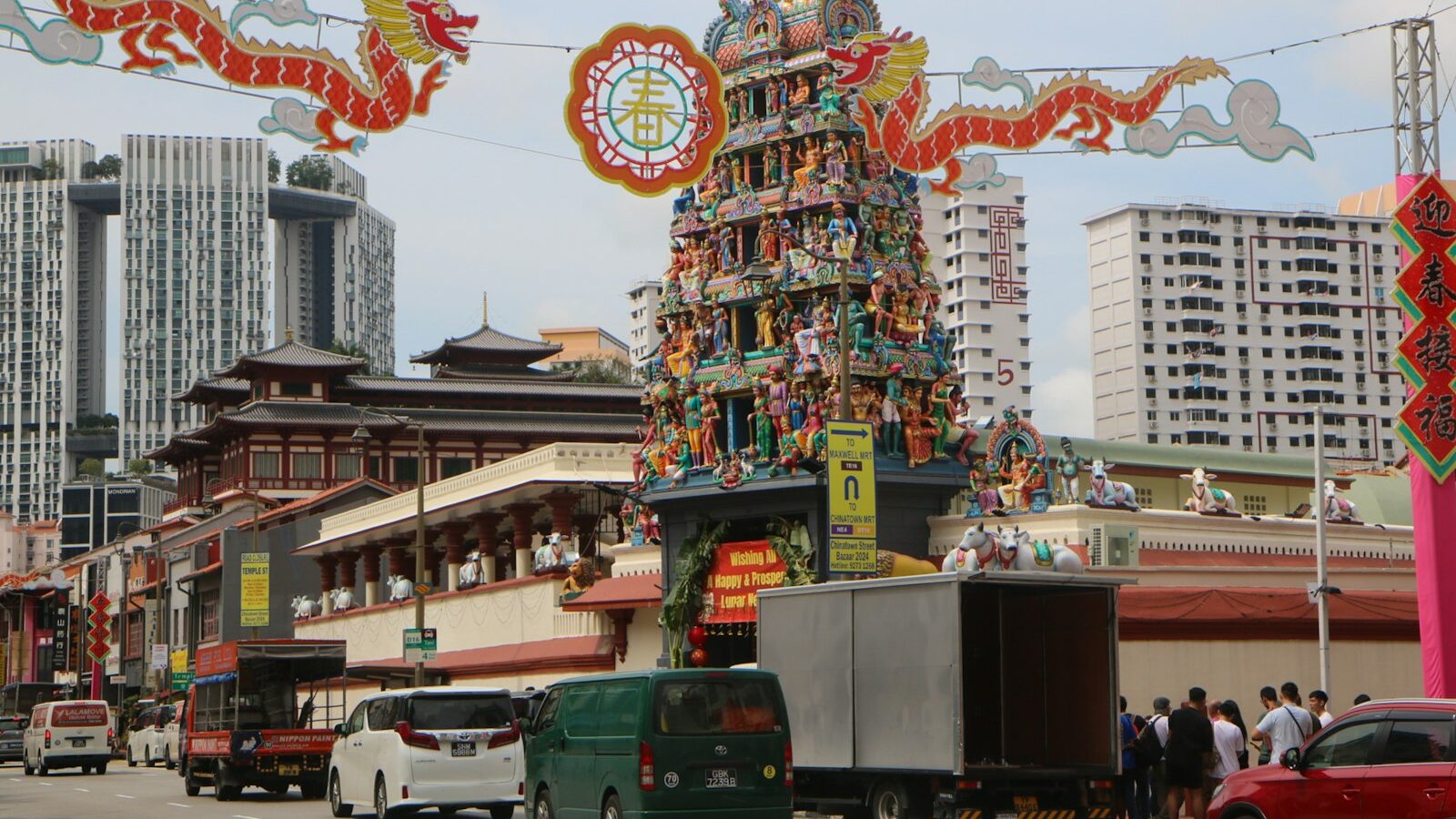
If you grew up in China, you probably know Buddhist temples as grand halls with red pillars, golden statues of the Buddha and Guanyin, incense burners in the courtyard and monks in grey or brown robes chanting in Chinese. That is the Mahayana tradition, and Singapore has many temples like this. But walk into a Theravada temple in Singapore, or a Tibetan Buddhist centre, and you may find the statues, robes, chanting and even the food quite different.
Singapore’s mix of Chinese, Thai, Burmese, Sri Lankan, Tibetan and other communities means all three major Buddhist traditions are present here. Vesak, usually in May, is a good time to explore them, as temples of every tradition hold celebrations and welcome visitors. This guide explains the main differences in plain terms, so the unfamiliar feels less strange.
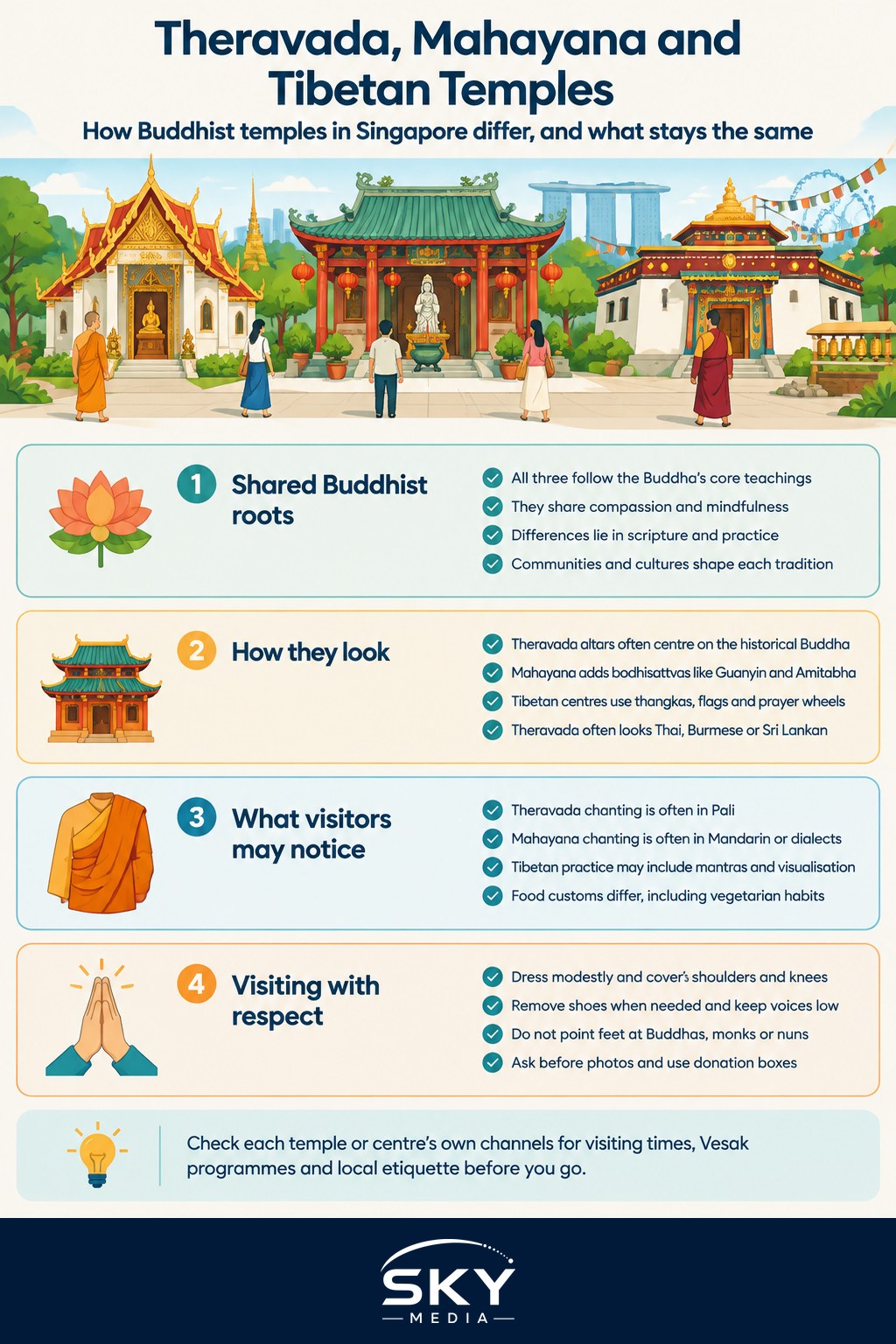
A Quick Overview of the Three Traditions
All three traditions share the core teachings of the Buddha, such as the Four Noble Truths, compassion and the path to ending suffering. They differ mainly in which scriptures they emphasise, how they practise, and the cultures they grew up in.
- Theravada (“the teaching of the elders”) is the main tradition in Sri Lanka, Thailand, Myanmar, Laos and Cambodia. Its scriptures are in the ancient Pali language. In Chinese it is often called 南传佛教 (Southern Buddhism).
- Mahayana (“the great vehicle”) spread through China, Taiwan, Korea, Japan and Vietnam. It is the form most mainland Chinese visitors know, often called 汉传佛教 (Chinese Buddhism), and its scriptures are commonly chanted in Chinese.
- Tibetan Buddhism, often grouped under Vajrayana, developed in Tibet and the Himalayan region. It is known in Chinese as 藏传佛教. It uses rich ritual, mantras, visualisation and colourful imagery.
These are broad descriptions. Practices vary between temples, teachers and communities, and many Singapore Buddhists visit temples of more than one tradition.
How the Temples Look and Feel
The quickest way to tell the traditions apart is often just to look around.
| Feature | Theravada temple | Mahayana temple | Tibetan centre |
|---|---|---|---|
| Main figures on the altar | Mostly the historical Buddha (Shakyamuni) | Shakyamuni plus bodhisattvas such as Guanyin, Amitabha and Medicine Buddha | Buddhas, bodhisattvas, protector figures and revered teachers |
| Architecture | Thai, Burmese or Sri Lankan styles, often white and gold, sometimes with stupas or tiered roofs | Chinese palace-style halls, red pillars, curved roofs | Colourful thangka paintings, prayer flags, prayer wheels, often in smaller centres |
| Monastic robes | Saffron, orange or deep maroon | Grey, brown or yellow, often with a ceremonial outer robe | Maroon and yellow |
| Chanting language | Pali, sometimes with English or local language | Mostly Mandarin or other Chinese dialects | Tibetan, often with translations |
| Food customs | Monks traditionally eat before noon; meals are not always vegetarian | Monastics and many lay followers eat vegetarian | Practices vary; not always vegetarian |
The vegetarian point surprises many Chinese newcomers. In Chinese Mahayana Buddhism, vegetarianism is strongly linked to monastic discipline. In the Theravada tradition, monks traditionally accept whatever food is offered to them, so the emphasis is on the rule of not eating after midday rather than on a vegetarian diet. Neither is “more correct”, they simply grew from different customs.
Visiting a Theravada Temple in Singapore
Singapore has several well-known Theravada temples, including the Burmese Buddhist Temple, the Thai-influenced Sakya Muni Buddha Gaya Temple on Race Course Road (often called the Temple of a Thousand Lights) and the Sri Lankaramaya Buddhist Temple. There are also smaller Thai and Sri Lankan temples across the island. Check each temple’s own channels for visiting times and Vesak programmes.
What to expect:
- A calm, simple atmosphere. There is usually less incense smoke than in Chinese temples, and offerings tend to be flowers, candles and food for the monks.
- Sitting on the floor. Devotees often sit on mats facing the Buddha image. Sit with your feet tucked to the side or behind you, never pointing at the altar or at monks.
- Respect for monks. In Theravada custom, women generally avoid touching monks or handing objects directly to them. Follow what local devotees do, or place an offering on a cloth or table.
- Blessing strings and water. You may see monks chanting while holding a white string, or sprinkling water as a blessing. Visitors are often welcome to receive this.
- Vesak observances. Some devotees observe extra precepts for the day, listen to talks on the teachings, or join meditation sessions.
Visiting a Tibetan Buddhist Centre
Tibetan Buddhism in Singapore is mostly found in dharma centres rather than large standalone temples. Many are located in shophouses or commercial buildings and are run by resident or visiting teachers.
- Walk clockwise. When circling a stupa, shrine or prayer wheel, move in a clockwise direction.
- Prayer wheels. Spin them clockwise, gently. Each turn is believed to carry the mantras inside.
- Prostrations and offerings. Devotees may make full or half prostrations and offer water bowls, butter lamps or white scarves called khata.
- Teachings and pujas. Centres often hold regular chanting ceremonies (puja) and talks, many in English. Check their schedules before going.
Etiquette That Applies Everywhere
Whichever tradition you visit, a few habits are welcome:
- Dress modestly, covering shoulders and knees.
- Remove shoes before entering prayer halls when signs or other visitors indicate it.
- Speak softly and keep phones on silent.
- Do not touch statues or climb on structures for photos, and ask before photographing people or ceremonies.
- Do not point your feet at the Buddha image, monks or nuns.
- Donations are welcome but optional. Use the official donation boxes.
Tips for Mainland Chinese Newcomers
- Do not assume the rules you know. Burning large bundles of incense, for example, is common in some Chinese temples but may not be expected in a Theravada temple.
- Language. Theravada and Tibetan centres often use English for talks, which is helpful if you are improving your English. Some also offer Mandarin sessions.
- Same values, different form. Compassion, generosity and mindfulness are shared across all three traditions. Seeing them expressed differently is part of what makes Buddhism in Singapore interesting.
- A mirror of Singapore. Visiting several traditions is also a way to understand how different communities live side by side here, much as our guide to Singapore vs China tier-1 cities looks at everyday life differences.
Key Points to Remember
- Theravada, Mahayana and Tibetan Buddhism share core teachings but differ in scriptures, rituals and culture.
- A Theravada temple in Singapore usually focuses on the historical Buddha, uses Pali chanting and follows Southeast Asian or Sri Lankan customs.
- Tibetan centres are often smaller dharma centres with prayer wheels, thangkas and clockwise circling.
- Basic respect, modest dress and observing local devotees will help you feel at home in any of them.
Further reading: How to Read a Chinese Temple Plaque in Singapore · Burmese Buddhist Temple · The Temple of a Thousand Lights