
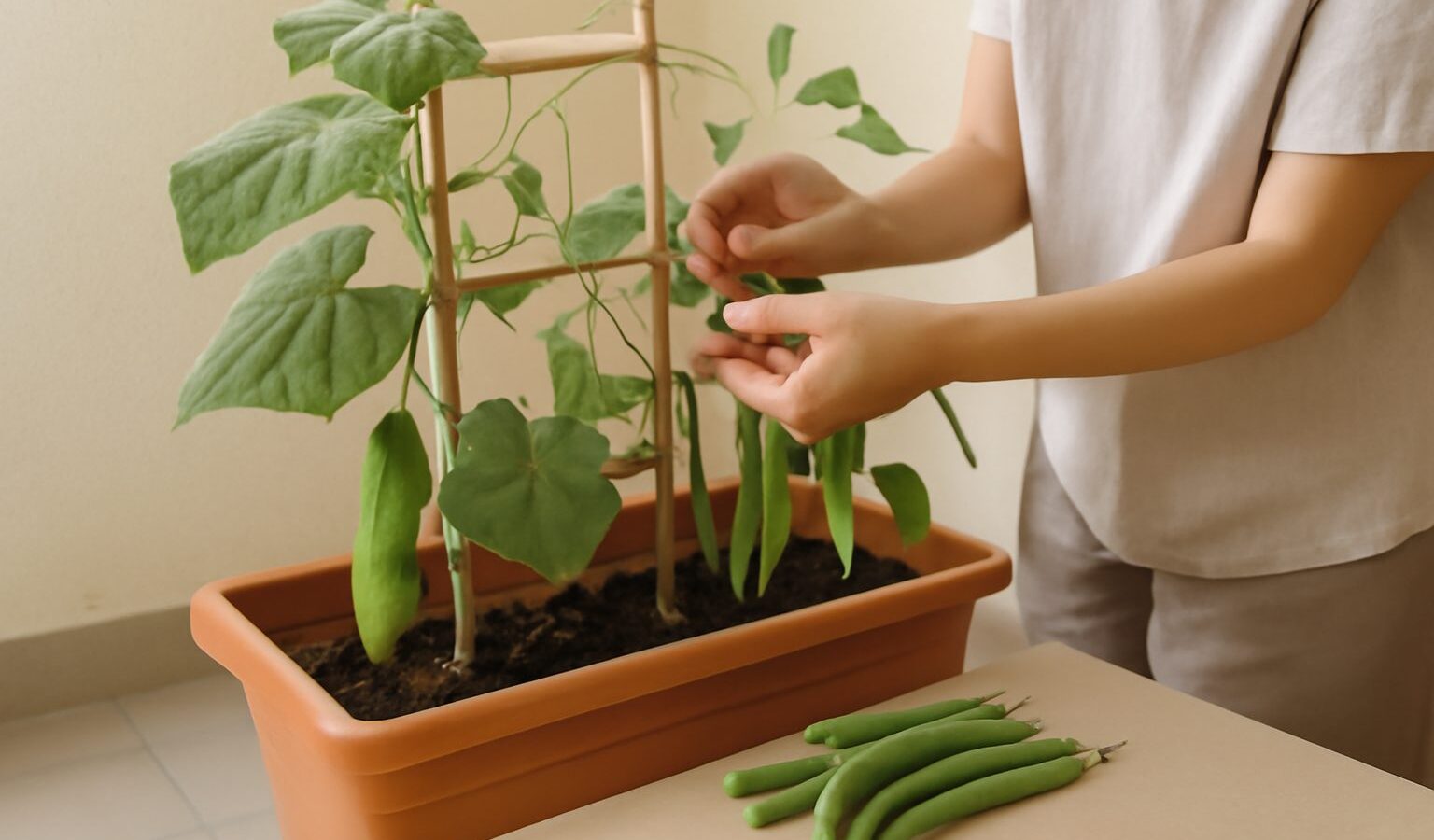
If you want to trellis cucumbers, beans and other edible climbers in a Singapore flat, the good news is that these plants actually prefer to grow up rather than out. A single planter on a balcony ledge or beside a corridor window can carry a surprising harvest when the vines have something sturdy to climb. The trick is choosing a support that suits your space, installing it before the plant needs it, and training the vines so they stay healthy, tidy and safe.
This guide focuses on the support itself: what kind of trellis works where, how cucumbers and beans climb differently, and how to keep everything secure in a high-rise home. For sowing, varieties and pest control, see our crop guides on growing cucumber and gourds at home and growing long beans and winged beans.
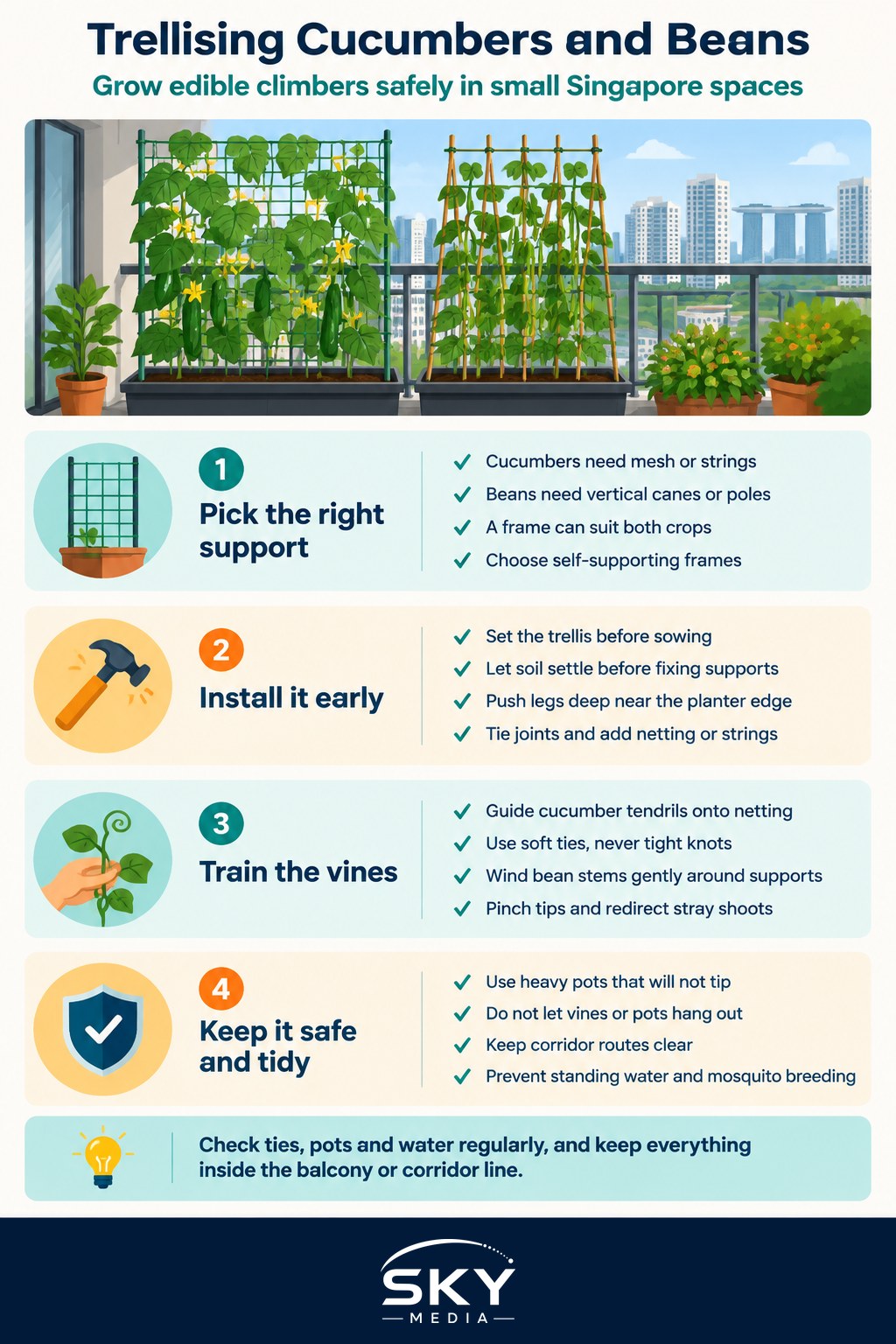
How Cucumbers and Beans Climb Differently
Before buying any support, it helps to understand how each plant holds on, because it changes what you should give them.
- Cucumbers and gourds climb with tendrils. These thin, curly shoots reach out and coil around anything narrow, such as string, netting or thin wire. They struggle to grip thick poles or flat surfaces, so a mesh or string support suits them best.
- Pole beans, long beans and winged beans climb by twining. The whole stem spirals around a vertical support. They love strings, thin bamboo canes and poles, but they climb up, not sideways, so horizontal wires do little for them.
- Bush or dwarf beans do not climb much at all. If space is very tight and you have no room for height, a bush variety in a deep pot may be easier. If you are deciding between types, our guide to growing French and snap beans explains the difference.
The practical takeaway: cucumbers want a grid, beans want verticals. A support that offers both, such as a net with a firm frame, will handle either crop.
Choosing a Trellis for Your Balcony or Corridor
Most Singapore homes have one of three growing spots: an enclosed balcony, a service yard, or a window ledge or corridor area outside the main door. Each has its own limits on height, width and what you are allowed to attach.
| Support style | Best for | Space needed | Things to watch |
|---|---|---|---|
| A-frame or ladder trellis in a planter box | Cucumbers and beans together | About one planter length, floor standing | Needs a heavy, deep planter so it does not tip in wind |
| Obelisk or teepee of bamboo canes | Long beans, pole beans, winged beans | A single large pot | Tie the top firmly; canes can slip in loose potting mix |
| Trellis net or mesh on a free-standing frame | Cucumbers, bitter gourd, small gourds | Narrow strip against a wall or grille | Use a frame, not the window grille, unless your landlord or rules allow it |
| Vertical strings from an overhead bar | Beans and single-stem cucumbers | Very narrow, good for tight balconies | Strings must be anchored at the bottom and tensioned |
A few general rules apply whichever you choose.
- Go for self-supporting frames. In HDB flats and many condos, drilling into walls or tying structures to window grilles may be restricted, and rented homes usually need landlord approval. A frame that stands inside its own planter avoids the question entirely.
- Height is about reach, not ambition. A trellis around head height is usually enough. Anything taller becomes hard to harvest, and tall structures catch more wind on upper floors.
- Match the pot to the trellis. The planter is the anchor. A deep, wide planter with plenty of soil weight is safer than a tall support in a small pot. For pot sizes and mixes, see our guide to container gardening for small spaces.
Installing the Support Before You Sow
Putting the trellis in first avoids damaging roots later and gives young vines something to find straight away.
- Fill the planter and settle the soil. Water the mix well and let it sink before inserting canes or frame legs.
- Push supports deep and close to the planter wall. The deeper the legs go, the steadier the frame. Leave the centre for roots.
- Lash joints with garden twine or cable ties. At the top of a teepee or along an A-frame, tie the crossing points tightly so the structure cannot splay.
- Add the climbing surface. Stretch netting or run strings now, while you can reach everything easily.
- Sow or transplant at the base. Place cucumbers a short distance from the net and beans right at the foot of each string or cane.
Training the Vines as They Grow
A trellis does not do all the work by itself. Young plants often wander, especially in the first week or two.
For cucumbers:
– Guide the first tendrils onto the lowest row of netting with your fingers. Once one tendril catches, the plant usually follows.
– Use soft ties, such as strips of old cloth or plant clips, to loosely attach the main stem every so often. Never tie tightly; stems thicken quickly.
– Many growers on small balconies keep cucumbers to one or two main stems and pinch out extra side shoots low on the plant. This keeps the vine within the trellis and improves airflow.
– Support heavy fruit if needed. Larger gourds may need a small sling made from old netting or cloth.
For beans:
– Wind the young stem gently around the string or cane in the same direction it is already turning. If you wind it the wrong way, it will usually unwind itself.
– Once a bean reaches the top of its support, pinch the growing tip. This encourages side branching lower down where you can actually pick.
– Long beans and winged beans can become vigorous in our heat. Redirect stray shoots back onto the frame every few days rather than letting them grab the grille or neighbouring plants.
Keeping a High-Rise Trellis Safe and Tidy
Growing up in a flat comes with responsibilities that ground-floor gardeners do not face.
- Secure everything against wind. Upper floors get strong gusts, especially during monsoon thunderstorms. Check ties after heavy weather and keep pots well inside the balcony.
- Nothing should hang outside the building. Pots, trellises and vines must not extend beyond the window or railing. Anything that could fall from height is dangerous and can be treated as a killer litter offence.
- Keep common corridors clear. If you garden near your front door, follow your town council’s rules on corridor items so escape routes stay unobstructed. A slim, low frame against your own wall is far less likely to be a problem than a sprawling setup.
- Prevent mosquito breeding. Empty saucers after watering, avoid water collecting in hollow bamboo canes by capping or cutting them just above a node, and check for stagnant water regularly. NEA enforces rules on mosquito breeding at home.
- Plan for the end of the season. Cucumbers and beans are short-lived. When the plant tires, cut the vine away from the net in sections rather than pulling, then reuse the frame for the next sowing.
Making the Most of a Small Vertical Patch
A small space rewards a little planning.
- Stagger sowings. Sowing a few seeds every couple of weeks gives a steadier supply instead of a glut followed by nothing.
- Use both sides of the frame. An A-frame can carry cucumbers on one face and beans on the other, as long as both get enough sun.
- Mind the sun direction. Edible climbers need several hours of direct sun. A trellis placed against the brightest side of the balcony will shade whatever sits behind it, so put shorter herbs in front.
- Harvest often. Picking beans and cucumbers young keeps the plant producing and stops heavy fruit from straining the support.
With a sturdy frame, gentle training and an eye on safety, a narrow balcony strip can become one of the most productive corners of your home.
Frequently Asked Questions
Can I grow cucumbers and long beans on the same trellis? Yes, an A-frame can carry cucumbers on one face and beans on the other, as long as both get enough sun. Cucumbers want a grid of string or netting, while beans want vertical strings or canes.
How tall should a balcony trellis be? Around head height is usually enough. Anything taller becomes hard to harvest and catches more wind on upper floors. A deep, wide, heavy planter is a safer anchor than a tall support in a small pot.
Can I tie my trellis to the window grille or drill into the wall? Drilling or tying to grilles may be restricted in HDB flats and many condos, and rented homes usually need landlord approval. A self-supporting frame that stands inside its own planter avoids the question.
How do I stop bamboo canes becoming a mosquito problem? Water can collect in hollow canes, so cap them or cut them just above a node. Also empty saucers after watering and check regularly for stagnant water, since NEA enforces rules on mosquito breeding at home.
When should I pinch the tip of a bean plant? Once it reaches the top of its support. Pinching the growing tip encourages side branching lower down, where you can actually pick. Keep redirecting stray shoots back onto the frame every few days.