
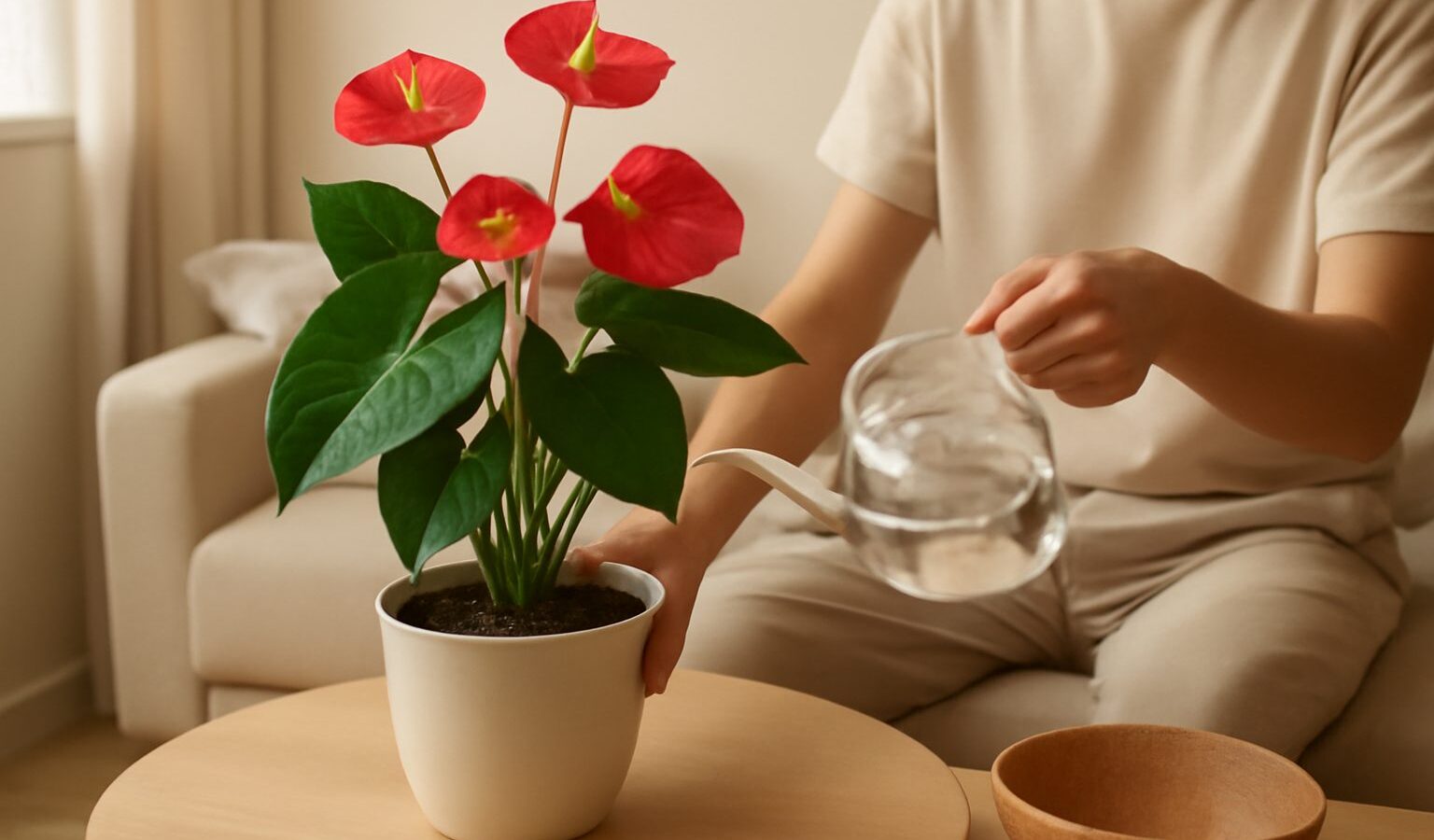
Few houseplants earn their keep like the anthurium. Those waxy, heart-shaped blooms in scarlet, coral or pure white can last for weeks, and a healthy plant flowers on and off all year in our climate. Good news for beginners: anthurium care is genuinely forgiving once you understand that this is a tropical rainforest plant, which is exactly the conditions a Singapore home already provides. Get the light, watering and humidity roughly right and you will be rewarded with a steady show of colour, even in a compact flat.
The colourful “flower” you admire is not a petal at all. It is a modified leaf called a spathe, and the true flowers are the tiny bumps on the upright spike, the spadix, in the centre. Knowing this helps you understand the plant: it is really a foliage plant that happens to produce long-lasting coloured bracts, so leaf health and flower health go hand in hand.
Getting the Light Right
Anthuriums grow beneath the forest canopy, so they want bright but filtered light, never harsh midday sun. A spot near an east-facing window, or a metre or two back from a bright balcony door, is close to ideal. On an HDB corridor or a sheltered balcony, morning light with shade through the afternoon suits them well.
Watch the plant and it will tell you what it needs. Too little light and it stays green and leafy but stops producing those coloured spathes, sulking as a foliage plant. Too much direct sun, especially the fierce late-morning glare we get here, scorches the leaves with pale or brown patches. If your only bright window gets strong sun, a sheer curtain softens it nicely. Rotate the pot a quarter turn every week or so, otherwise the plant leans towards the light and grows lopsided.
Watering and Humidity in Our Climate
The most common way to kill an anthurium is overwatering, so let the top of the mix dry before you water again. Push a finger about two centimetres into the potting mix; if it feels damp, wait. When you do water, water thoroughly until it runs from the drainage holes, then let it drain completely. Anthuriums hate sitting in soggy mix, which quickly rots their thick roots.
Here is the local catch. Never leave the drainage saucer full of water. Standing water in saucers and pot trays is a classic breeding spot for Aedes mosquitoes, which spread dengue, so tip out any collected water within minutes and check trays at least weekly. A raised pot foot or a layer of pebbles that keeps the pot base above the water line helps, as long as no water actually pools and stagnates. Follow current NEA and NParks guidance on preventing mosquito breeding at home.
Humidity is where Singapore genuinely helps you. Anthuriums love the muggy air that makes the rest of us reach for the aircon. The problem is the aircon itself, which dries indoor air right out. If your plant lives in an air-conditioned room, keep it away from the cold draught and mist it in the mornings, or stand it on a tray of damp pebbles for a gentle humidity boost. Brown, crispy leaf edges usually mean the air is too dry.
Soil, Feeding and Repotting
Anthuriums are semi-epiphytic, meaning in the wild they perch on trees rather than sit in dense soil. Their roots need air. A heavy, water-retentive potting mix suffocates them, so use a chunky, free-draining blend. A mix of ordinary potting soil loosened with orchid bark, perlite and a little coco chips works beautifully and mimics their natural footing. Always use a pot with drainage holes.
Feed lightly during our year-round growing season. A balanced liquid fertiliser at half the label strength every three to four weeks is plenty; anthuriums are not heavy feeders, and too much fertiliser burns the roots and pushes leaves at the expense of flowers. A fertiliser slightly higher in phosphorus can encourage more blooms, but gentle and regular beats strong and occasional.
Repot only every two years or so, or when roots creep out of the drainage holes and the plant dries out too fast. Go up just one pot size; anthuriums actually flower better when a touch snug. When you repot, you may notice aerial roots reaching up the stem. Tuck the lower ones into fresh mix and leave the rest, or wrap them loosely with damp sphagnum moss.
Common Problems and How to Fix Them
Most anthurium troubles trace back to watering or light, and the plant recovers quickly once you correct the cause. Use this quick guide to match a symptom to its likely fix.
| Symptom | Likely cause | What to do |
|---|---|---|
| Yellowing lower leaves | Overwatering or soggy mix | Let mix dry more; check drainage holes are clear |
| Brown, crispy leaf tips | Dry air, often from aircon | Raise humidity; move away from cold draughts |
| Leaves but no blooms | Too little light or over-feeding | Move to brighter filtered light; ease off fertiliser |
| Pale, scorched patches | Direct sun | Shift to filtered light or add a sheer curtain |
| Sticky spots or fine webbing | Sap-sucking pests | Wipe leaves; treat with insecticidal soap or neem |
For pests such as mealybugs, scale or spider mites, start with the least-toxic approach. Wipe the leaves with a damp cloth, rinse the plant under a gentle shower and treat with insecticidal soap or neem oil, repeating weekly until clear. If you ever use a stronger product, follow the label exactly, keep it away from children and pets, and apply in a ventilated spot. Wiping the broad leaves clean of dust every few weeks also keeps them glossy and helps them breathe.
A Safety Note Worth Remembering
Anthuriums are lovely to look at but not to eat. Like many aroids, every part contains calcium oxalate crystals, so the plant is not edible and can cause painful burning and swelling of the mouth if chewed. The sap can also irritate skin. Keep anthuriums out of reach of young children and curious pets, and wear gloves when repotting or dividing so the sap does not bother sensitive skin. Wash your hands afterwards. Treated with this simple respect, an anthurium is a perfectly safe and rewarding houseplant.
Explore More
Anthuriums sit within the wider aroid family, so if you enjoy them you will feel right at home with related tropical foliage. Read our companion guide to caring for alocasia and other aroids, or try the equally hardy peace lily. For a leafy contrast on the same shelf, our guide to growing calatheas in Singapore pairs perfectly.