
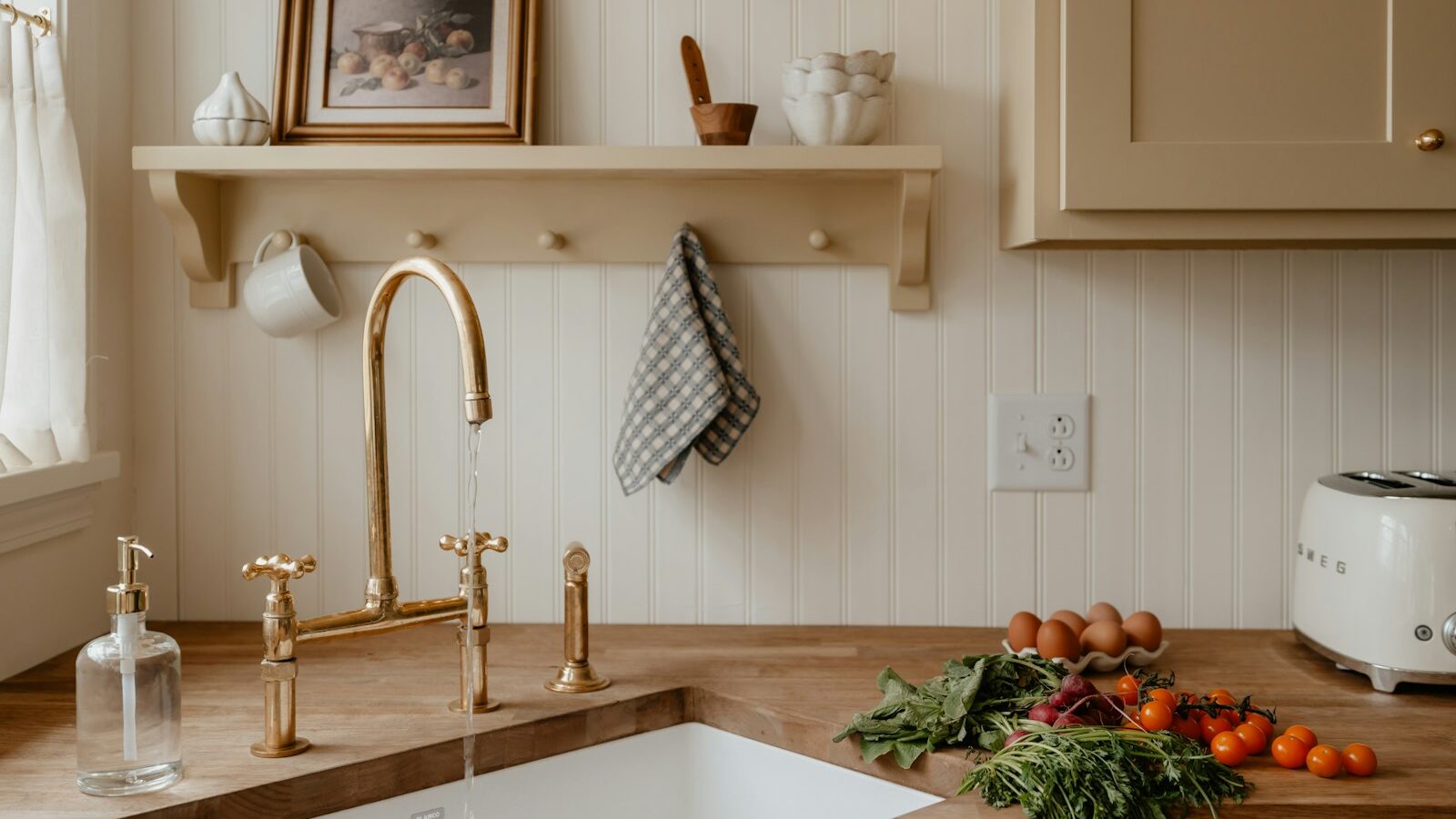
The kitchen tap is used more than almost anything else in a Singapore home. It fills the rice pot, rinses vegetables, washes the wok after a stir-fry and runs dozens of times a day. Yet many people pick one in a hurry during renovation, only to find later that the spout hits the window ledge, the finish shows every water spot, or the hose sags. Choosing a kitchen tap in Singapore well comes down to a few practical questions: what type of tap you need, whether it fits your sink and counter, what finish will survive daily use, and how water efficient it is.
This guide focuses on the tap itself. If you are still deciding on the basin, start with our guide on how to choose a kitchen sink for your Singapore home, since the two need to work together.
Types of Kitchen Tap and Who They Suit
Here are the main styles you will see in showrooms and online.
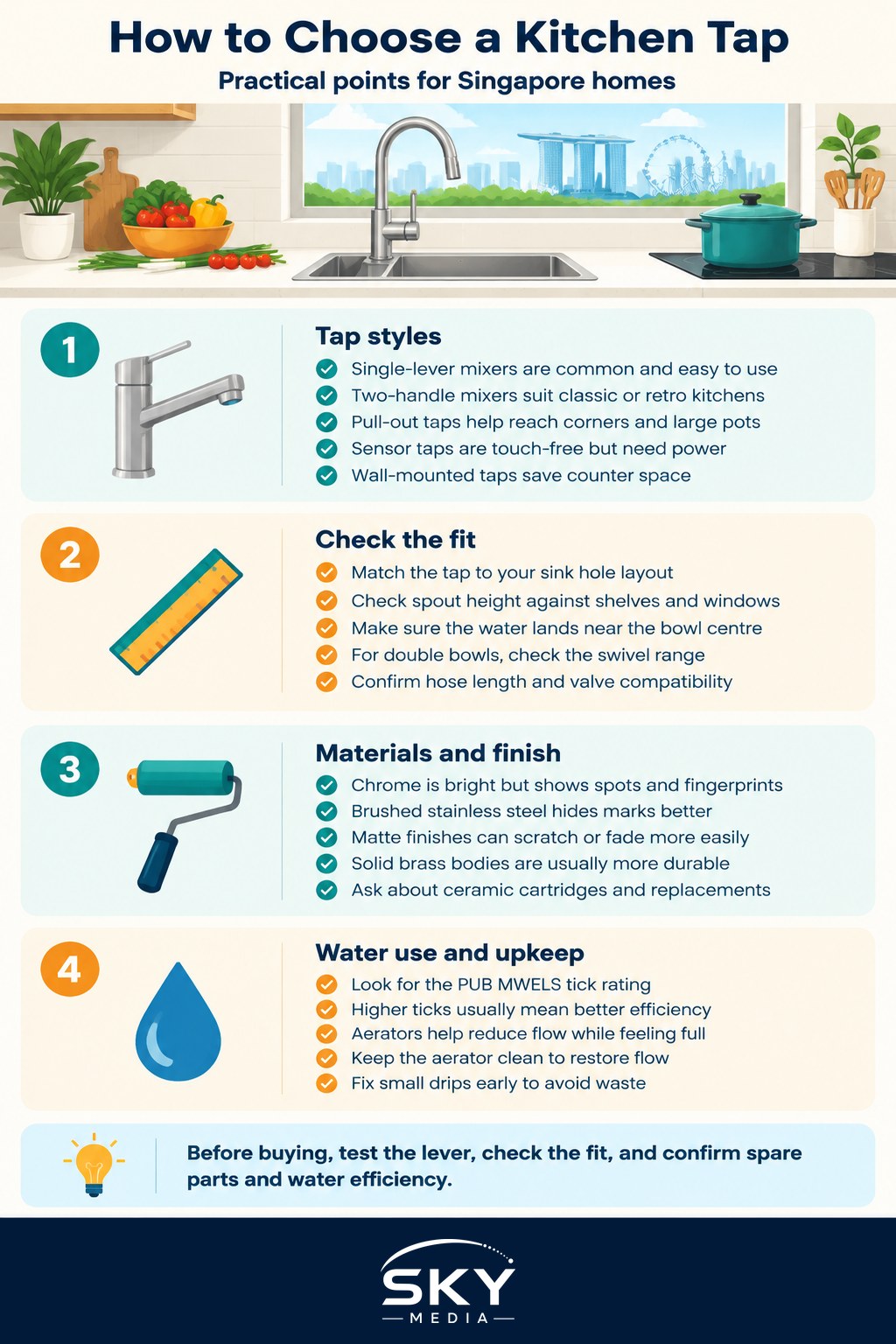
- Single-lever mixer. One handle controls both flow and temperature. It is the most common kitchen tap in Singapore homes today because you can operate it with a wrist or elbow when your hands are greasy.
- Two-handle mixer. Separate hot and cold handles feeding one spout. It has a classic look and suits some traditional or retro kitchens, but it takes two hands to adjust.
- Single-cold tap (pillar tap). Cold water only. Many HDB kitchens historically had cold water only at the sink, so if you have no hot water supply to the kitchen, a simple cold tap may be all you need.
- Pull-out or pull-down tap. The spray head detaches on a hose so you can rinse the corners of a large sink, fill a pot sitting on the counter, or wash down a deep basin. Many models switch between stream and spray.
- Sensor (touchless) tap. Runs water when it detects a hand or object. Useful for hygiene when handling raw meat, but it needs power (battery or mains) and can be triggered accidentally.
- Wall-mounted tap. Fixed to the backsplash rather than the counter. Saves counter space and makes the area behind the sink easier to clean, but needs plumbing in the wall, which is usually only practical during a renovation.
Comparing the Main Options
| Tap type | Main advantage | Main drawback | Best for |
|---|---|---|---|
| Single-lever mixer | Easy one-hand control of flow and temperature | Needs both hot and cold supply to use fully | Most households with a water heater to the kitchen |
| Pull-out or pull-down | Flexible spray reaches all corners and pots | Hose and retraction weight can wear over time | Large or double-bowl sinks, frequent cooks |
| Sensor tap | Touch-free, less cross-contamination | Needs batteries or power, costs more to repair | Hygiene-focused kitchens, families with young children |
| Cold-only pillar tap | Simple, cheap to replace, few parts to fail | No temperature control | Kitchens without hot water, service yards |
Checking the Fit: Height, Reach and Mounting
Most tap complaints are really fit problems. Before you buy, measure and check these points.
- Tap hole. Look at how many holes your sink or counter has and their size. A one-hole mixer will not fit neatly into a two-hole layout without a cover plate, and vice versa.
- Spout height. Tall gooseneck spouts make it easy to fill big pots, but check the clearance under any window, cabinet or shelf above the sink. Also check that the window can still open.
- Spout reach. The water should land roughly near the middle of the bowl, not at the back edge. Too short and you splash the back of the sink; too long and water hits the front edge and drips onto the floor.
- Swivel range. For double-bowl sinks, make sure the spout swings far enough to serve both bowls.
- Supply connections. Most mixers use flexible hoses that connect to the angle valves under the sink. Check that your existing valves and hose lengths suit the new tap, or plan to replace them at the same time.
- Hot water supply. A mixer only gives warm water if there is a hot water line to the kitchen. Many older flats run hot water only to the bathrooms. Adding a kitchen hot water line or a small under-sink heater is a job for a licensed plumber.
If you live in an HDB flat or condominium, plumbing work may involve rules from HDB or your MCST (Management Corporation Strata Title, the body that manages a condo). Check with them and use a licensed plumber listed with PUB, Singapore’s national water agency, for anything beyond a straight swap.
Finishes and Materials That Last
Singapore’s humidity and the minerals in tap water both affect how a tap looks after a few years.
- Chrome plating. Bright, affordable and widely available. It shows water spots and fingerprints, and cheaper plating can peel near the base if harsh cleaners are used.
- Brushed or satin stainless steel. Hides water marks and fingerprints better than chrome and pairs well with stainless sinks. Solid stainless steel bodies resist corrosion well.
- Matte black and coloured finishes. Striking, but some coatings can scratch or fade with abrasive sponges. Ask the seller about the coating type and cleaning instructions.
- Brass body. Many quality taps have a solid brass body under the finish, which is durable. Lightweight taps that feel hollow or flimsy are often a sign of cheaper construction.
- Ceramic disc cartridge. Inside a lever mixer, a ceramic cartridge controls flow. Good cartridges turn smoothly and resist dripping for years. Ask whether replacement cartridges are available locally.
For keeping any finish looking good, our guide on how to clean your kitchen sink and taps covers gentle routines that avoid stripping plating.
Water Efficiency Labels and Flow
In Singapore, taps sold for household use come under PUB’s Mandatory Water Efficiency Labelling Scheme (MWELS). The label uses a tick rating: more ticks mean a more water-efficient product. When comparing taps, look for the label on the packaging or product listing and favour higher tick ratings where the price difference is reasonable.
A few points to keep in mind:
- An efficient tap usually uses an aerator or flow regulator to mix air into the water, which keeps the stream feeling full while using less.
- Very low flow can feel slow when filling large pots. A pull-down tap with a strong spray mode, or simply filling pots at a higher lever position, can help.
- Rules and rating bands can change, so check PUB’s website for current MWELS requirements rather than relying on old product packaging or a seller’s summary.
If you are new to Singapore’s water supply and wondering about drinking straight from the tap, see our explainer on tap water and home essentials in Singapore.
Buying, Installing and Looking After Your Tap
A few final habits help you avoid regrets.
- Handle it before you buy. In a showroom, move the lever through its range. It should feel smooth and stay where you leave it.
- Check warranty and spare parts. Ask how long the warranty runs, what it covers, and whether cartridges, aerators and pull-out hoses can be bought separately.
- Keep the box and manual. These list the model number you will need for spare parts later.
- Clean the aerator. Every few months, unscrew the aerator at the spout tip and rinse out grit or scale. It restores flow and reduces splashing.
- Act on drips early. A small drip wastes water and usually points to a worn cartridge or washer. Our guide on how to fix a leaky tap walks through the common fixes.
Choose the type that matches how you cook, measure carefully for fit, pick a finish you are happy to clean, and check the water efficiency rating. Do that and your kitchen tap will quietly do its job for many years.
Further reading: How to Clean a Clogged Tap Aerator to Restore Water Pressure