
Lithops, often called living stones, are small succulents from the dry regions of southern Africa that look like pairs of pebbles. They are charming, cheap to start with and easy to kill. Good lithops care in Singapore is less about doing more and more about doing less at the right time: a fast-draining mix, as much bright light as you can give, and water timed to the plant’s own leaf cycle rather than to the calendar.
This guide focuses only on lithops and their close relatives, such as Conophytum and Pleiospilos. General succulents and cacti are far more forgiving, so habits that work for an aloe or a jade plant can quietly rot a lithops in a humid flat.
Why Lithops Struggle in Singapore’s Humidity
In their native habitat, lithops sit almost buried in mineral soil, take most of their moisture from occasional rain and fog, and endure long dry spells. Singapore offers the opposite: high humidity all year, frequent heavy showers and warm nights. Three problems follow.
- Slow drying. Soil that would dry in two days in a desert can stay damp for a week in a shaded HDB corridor. Constantly damp roots are the main cause of lithops rot.
- Low light indoors. A lithops on a living room shelf gets a fraction of the light it needs. It stretches upward, loses its compact shape and turns pale green.
- Water absorbed from the air. The plant still draws some moisture from humid air, so it needs less watering here than care guides written for dry climates suggest.
Soil, Pots and Placement
A gritty, mostly mineral mix
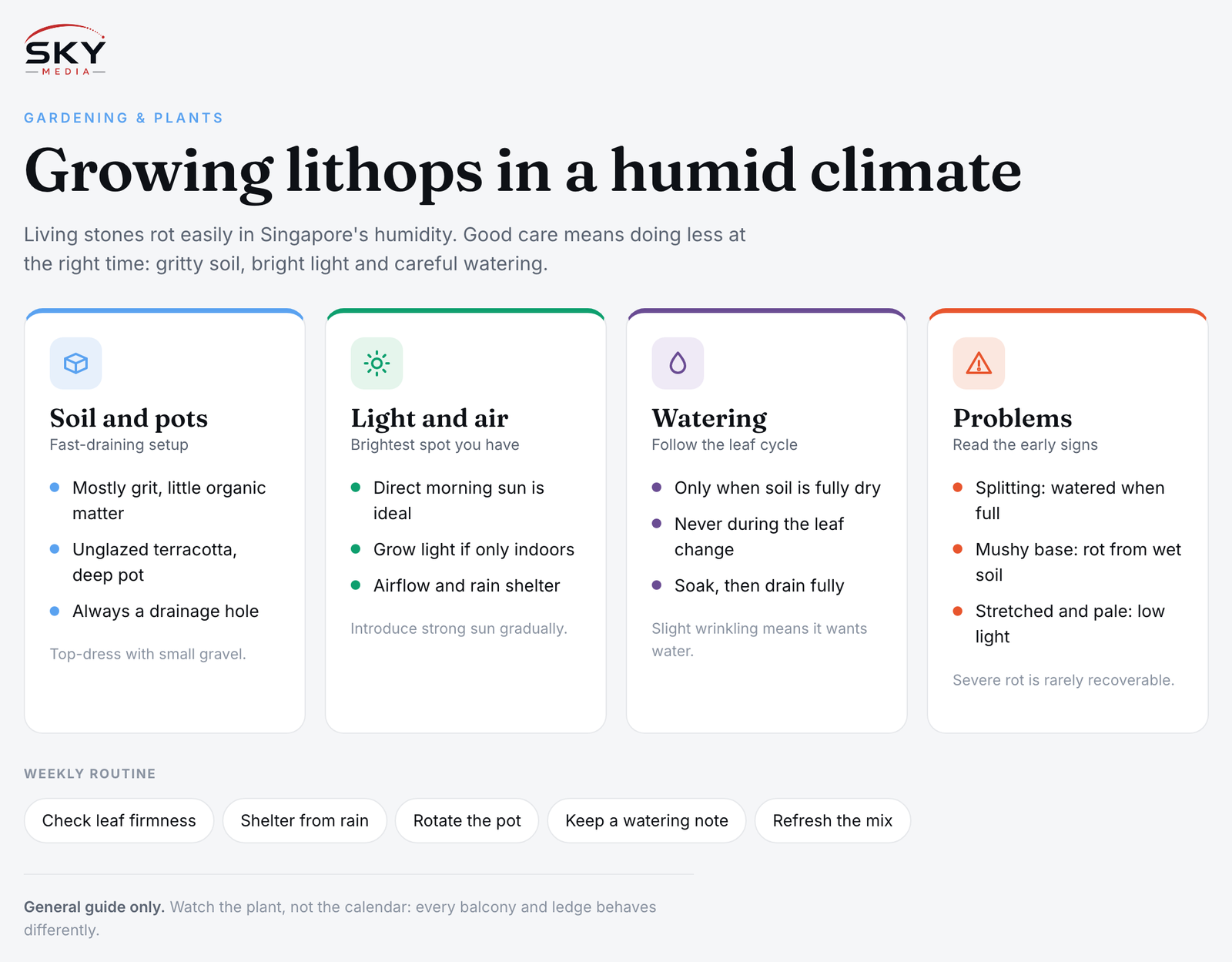
Ordinary potting soil holds far too much water. Aim for a mix that is mostly inorganic grit with only a small amount of organic matter. Common ingredients sold at local nurseries and online gardening shops include pumice, perlite, akadama, coarse sand and crushed lava rock. Many growers use roughly three or four parts grit to one part cactus soil, adjusting by feel. The test is simple: water should run straight through, and the mix should feel nearly dry to the touch within a few days.
Top-dress with a layer of small gravel so the plant body does not sit against damp soil. This also helps you see the plant clearly, which matters when you are reading its leaf cycle.
Pots that breathe
Unglazed terracotta pots dry faster than plastic or glazed ceramic, which suits our weather. Lithops have long taproots, so a pot that is deeper than it is wide works better than a shallow dish. Every pot must have a drainage hole. Decorative pots without holes are the quickest way to lose a lithops in Singapore.
Light and airflow
Give lithops the brightest spot you have. A balcony or window ledge with several hours of direct morning sun is ideal. Strong afternoon sun through glass can scorch, so introduce new plants to direct sun gradually over a couple of weeks. If you only have indoor light, a small full-spectrum grow light placed close above the plants works well and lets you keep them away from rain.
Airflow is just as important as light. A spot near an open window or with a gentle fan helps the soil dry and discourages fungal problems. Shelter plants from monsoon downpours: a covered ledge or a spot under the eaves stops a week of rain from waterlogging the pot.
Watering in Step With the Leaf Cycle
Lithops care is mainly about watering, and watering is mainly about watching the leaves. Each year, a new pair of leaves grows inside the old pair. The old leaves gradually shrivel as the plant moves their water and nutrients into the new ones. If you water during this phase, the old leaves stay plump, the new pair is squeezed, and the plant can rot or split.
In Singapore the seasons are weak signals, so the plant may not follow a neat timetable. Watch the plant, not the month. The table below shows what each phase looks like and how to respond.
| Phase | What you see | Watering approach |
|---|---|---|
| Active growth | Firm, plump leaves; the plant looks settled | Water thoroughly only when the soil is fully dry and the leaves show slight softening or wrinkling |
| Flowering | A bud emerges from the fissure between leaves, usually followed by a daisy-like flower | Water lightly and only if the plant is visibly wrinkled |
| New leaves forming | Old pair starts to split open and a new pair appears inside | Stop watering; let the old leaves feed the new ones |
| Old leaves shrivelling | Old pair becomes thin, papery skins | Keep dry; do not peel the old skins off |
| Dormant or stressed | Plant sinks lower into soil and looks dull | Water sparingly, a small drink only if heavily wrinkled |
How to water
When it is time to water, soak the pot until water runs from the drainage hole, then let it drain fully. Do not leave the pot standing in a saucer of water. Then wait until the mix is completely dry again before considering the next watering. A wooden skewer pushed into the mix and left for a few minutes is a helpful check: if it comes out damp or cool, wait.
A light, slightly wrinkled look is normal and is the plant asking for water. Leaves that are soft, translucent or mushy are a sign of too much water, not too little.
Spotting and Fixing Common Problems
Most lithops problems in humid climates trace back to water and light. Learn to read the early signs.
- Splitting or cracked leaves. Usually caused by watering when the plant is already full, especially during the leaf change. Hold off watering; the damaged pair will often be replaced in the next cycle.
- Mushy base or blackened body. Rot, generally from wet soil. Remove the plant, cut away soft tissue if any healthy material remains, let it dry for several days, and repot in fresh dry grit. Severe rot is rarely recoverable.
- Tall, stretched, pale plants. Too little light. Move gradually to a brighter spot or add a grow light.
- Bleached or brown patches. Sunburn from a sudden jump into strong sun. Provide light shade and acclimatise slowly.
- Fine webbing or white fluff. Possible spider mites or mealybugs. Isolate the plant and treat with a suitable product from a garden centre, following the label.
Buying and Starting Out
Lithops are sold at nurseries, plant markets and online shops, often as small potted plants or seed. A few practical tips help beginners.
- Choose plants that are firm, plump and evenly coloured, with no soft spots or signs of rot at the base.
- Repot from dense nursery soil into a gritty mix soon after purchase, but only when the plant is not mid leaf change. Leave it dry for about a week after repotting so any damaged roots can heal.
- Group several plants with similar needs in one deep pot. This makes watering decisions easier because they tend to follow similar cycles.
- Keep a simple note of when you watered and what the leaves looked like. Over a year you will learn how your particular spot behaves.
A Simple Routine for Busy Growers
If you want a low-effort approach, this rhythm suits most Singapore balconies and sunny ledges:
- Check plants once a week, looking at leaf firmness and any signs of splitting.
- Water only when the soil is fully dry and the leaves are slightly soft, and never during the leaf change.
- Move plants under shelter when a rainy spell is forecast.
- Rotate the pot every week or two so growth stays even.
- Refresh the gritty mix every couple of years, or when it breaks down and stays wet longer.
Done this way, lithops care becomes a slow, quiet hobby that fits well with small-space living. If you enjoy matching plants to Singapore’s climate, see our guides to growing sweet osmanthus in a tropical climate and growing a living hedge or privacy screen.
Further reading: Growing Rhipsalis (Mistletoe Cactus) in Singapore · Growing Echeveria and Rosette Succulents · Growing Desert Rose Adenium in Singapore